
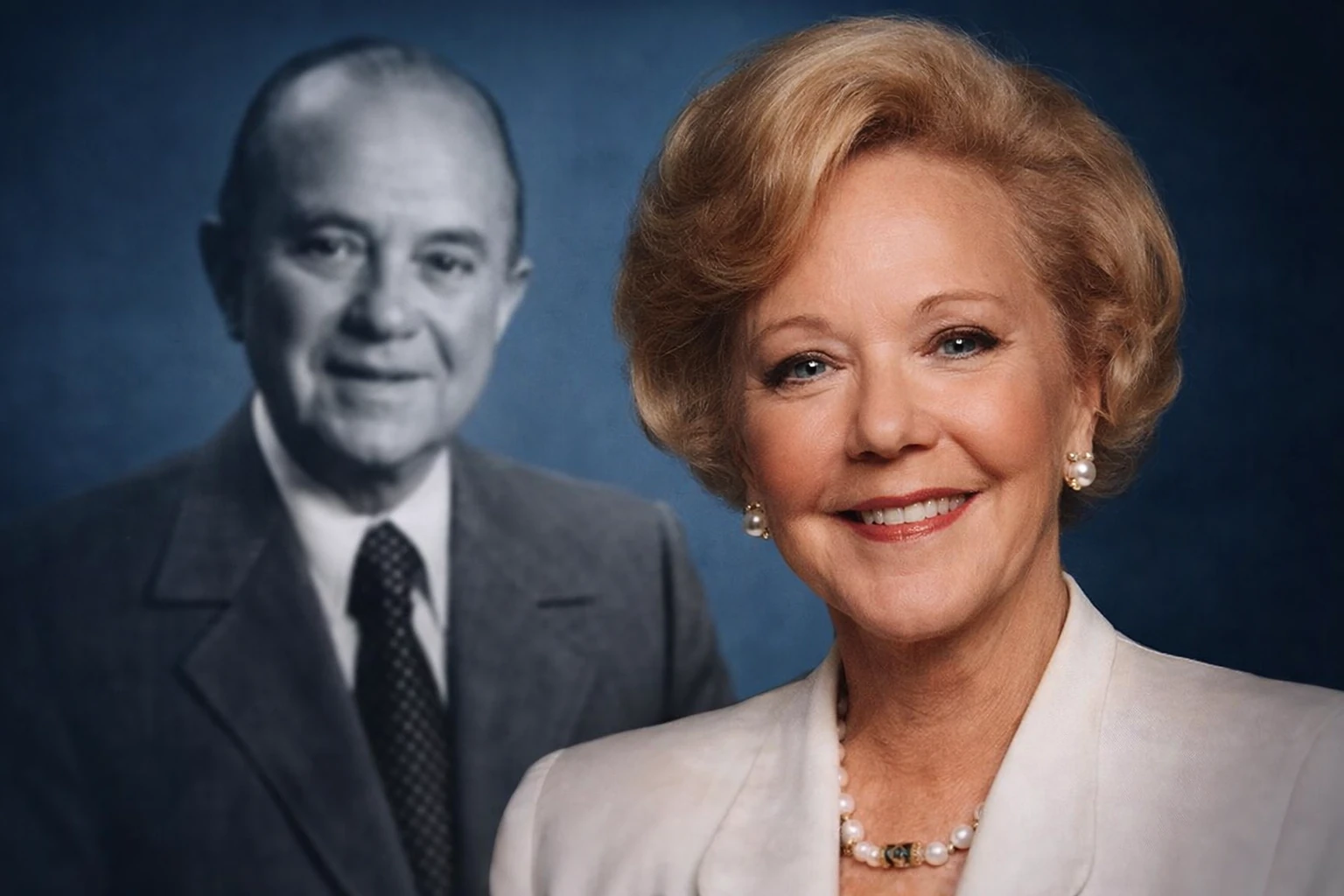
If you expected a tale of boardrooms, corporate influence, or inherited billions, the truth moves in a different direction. Marilyn’s life unfolded largely outside the public gaze, long before McDonald’s became a global symbol. That contrast—between a father who became a business icon and a daughter who remained deeply private—is what makes her story linger.
Early Life and Family Background
Marilyn Janet Kroc was born on October 15, 1924, in Chicago, Illinois. At the time, her father Ray Kroc was far from the name people recognize today. He was working various sales jobs, trying to find stability during a period that tested many American families. Her mother, Ethel Janet Fleming, provided a more grounded presence, and by most accounts, Marilyn’s early life followed a relatively ordinary Midwestern rhythm.
Chicago in the 1920s and 1930s wasn’t an easy place to grow up, especially during the Great Depression. Families learned to stretch resources, and ambition often took a back seat to survival. Ray Kroc spent those years selling paper cups and later Multimixer milkshake machines, jobs that required constant travel and persistence. That meant Marilyn’s childhood likely included stretches of absence from her father, even before his career truly took off.
By all accounts, she grew up before the wealth, before the brand, and before the mythology. That timing matters more than it first appears. Marilyn didn’t grow up as the daughter of a fast-food mogul. She grew up as the daughter of a salesman trying to make something of himself, and that difference shaped the texture of her early years.
Growing Up Before McDonald’s Fame
What’s surprising is how often Marilyn’s life gets rewritten as if she witnessed the rise of McDonald’s from a front-row seat. The dates simply don’t support that version. Ray Kroc didn’t become involved with McDonald’s until 1954, when he visited the McDonald brothers’ restaurant in California. By then, Marilyn was already 30 years old.
That means her formative years were shaped entirely outside the shadow of the Golden Arches. She would have experienced her father’s ambitions in a more uncertain form, watching him pursue opportunities that hadn’t yet paid off. Anyone who has lived in a household with an entrepreneurial parent knows that mix of hope and instability. It’s rarely glamorous in the moment.
Her adulthood began just as her father’s life was about to change dramatically. In 1955, Ray Kroc opened his first McDonald’s franchise in Des Plaines, Illinois. From that point forward, his trajectory shifted upward at a pace few could have predicted. But Marilyn was not a child watching it unfold. She was already building her own life.
Personal Life and Marriages
Public records show that Marilyn Kroc married more than once, though the details remain uneven and sometimes inconsistent across sources. Her most clearly documented marriage was to James Walter Barg, and by the time of her death, she was known publicly as Lynn J. Barg. The use of “Lynn” suggests a nickname or preferred name among family and friends, offering a small glimpse into how she may have been known privately.
Marriage records and memorial listings also reference an earlier marriage to Sylvester Nordly Nelson, though the specifics of that relationship are less clear. This kind of partial record is common for individuals who lived outside public scrutiny. Unlike celebrities or business leaders, their personal milestones were not widely reported or preserved in detail.
Her life appears to have been centered in Illinois, particularly in areas like Evanston and Arlington Heights. Those suburban communities, especially in the mid-20th century, were places where privacy was both expected and respected. That environment likely allowed Marilyn to maintain distance from the growing fame of her father.
Relationship with Ray Kroc
Any attempt to understand Marilyn Kroc Barg eventually circles back to her relationship with her father. Ray Kroc’s rise to prominence was not only rapid but also consuming. He became deeply involved in expanding McDonald’s, shaping its systems, branding, and franchise model with relentless focus.
The truth is, there isn’t a detailed public record of their personal relationship. That absence says something in itself. While Ray Kroc wrote about his business life and philosophies in his autobiography, his daughter does not appear prominently in those accounts. That omission doesn’t necessarily signal distance, but it does suggest that their relationship remained private.
What we do know is that Ray Kroc’s first marriage to Ethel Fleming ended in divorce in 1961. Family changes like that rarely leave children unaffected, even when those children are already adults. Marilyn would have been in her late 30s at the time, navigating her own life while her father’s public identity continued to expand.
Life During the McDonald’s Expansion
The 1950s and 1960s were transformative decades for McDonald’s. The company introduced its franchising model, standardized operations, and expanded across the United States at a pace that redefined fast food. Ray Kroc became synonymous with efficiency, consistency, and scale.
Marilyn, meanwhile, remained largely out of that story. There is no credible evidence that she held a formal role within McDonald’s corporate structure. Many online articles suggest she was involved in the business or influenced its direction, but those claims lack reliable sourcing.
But here’s the thing. Being connected to a rapidly growing empire doesn’t automatically mean participation. Many family members of successful entrepreneurs choose to remain outside the business, either by preference or circumstance. Marilyn’s life appears to fit that pattern. She lived near the orbit of a global brand without stepping into its center.
Health Challenges and Early Death
Marilyn Kroc Barg’s life was cut short on September 11, 1973, when she died at the age of 48. That alone places her story in a different emotional frame. While her father would go on to live another decade and cement his legacy, Marilyn’s life ended before the Kroc name reached its most recognizable heights.
Some family-history sources report that her death was related to complications from diabetes. While that detail appears in multiple records, it is not explicitly stated in the surviving obituary notices, so it’s best understood as widely reported rather than definitively confirmed.
Her death notice, published in the Chicago Tribune, was brief and understated. It identified her as Lynn J. Barg, the wife of James Barg and the daughter of Raymond A. Kroc and the late Ethel J. Kroc. There was no mention of wealth, business, or public status. The funeral was private, reflecting a family that, at least in this moment, chose discretion over visibility.
Financial Standing and Inheritance Reality
One of the most persistent questions about Marilyn Kroc Barg concerns wealth. Did she inherit part of the McDonald’s fortune? Was she a hidden heiress? The timeline answers that question clearly.
Marilyn died in 1973. Ray Kroc died in 1984. Because she did not outlive her father, she could not have been the primary heir to the estate he left behind. That estate, along with its immense wealth, later became closely associated with Joan Kroc, Ray’s third wife.
Joan Kroc’s philanthropic legacy is well documented. After her death in 2003, reports described donations that included more than $1.5 billion to the Salvation Army and over $200 million to NPR. Those numbers reshaped public perception of the Kroc family’s impact, but they belong to a chapter Marilyn never saw.
As for Marilyn’s own financial standing, there is no reliable public figure for her net worth. Estimates vary widely across websites, but none are supported by credible documentation. The truth is simpler: her finances were private, and no verified record places her among the high-profile heirs of the McDonald’s empire.
Lesser-Known Details About Marilyn Kroc Barg
Not many people know this, but Marilyn was often referred to as “Lynn” in her later years, a detail that appears in official records rather than media accounts. That small shift in name hints at a personal identity separate from the public weight of “Kroc.” It suggests she may have preferred a quieter version of herself, one not immediately tied to her father’s growing fame.
There’s also the matter of timing, which shapes her entire story. Marilyn’s life overlapped with the early and middle phases of McDonald’s expansion but ended before the company reached its global dominance. That places her in a unique position, connected to the origin story but absent from the legacy phase most people recognize.
Another detail worth noting is how little direct documentation exists about her daily life. There are no widely circulated interviews, no public speeches, and no major profiles from her lifetime. Anyone who knew her personally would likely describe a woman who valued privacy, because that is exactly what the historical record reflects.
Why Her Story Still Matters
You might wonder why Marilyn Kroc Barg continues to attract attention decades after her death. The answer has less to do with what she did and more to do with what she represents. She is part of a larger story about family, legacy, and the uneven way history remembers people.
The truth is, public narratives often simplify complex lives. They highlight founders, innovators, and leaders, while quietly sidelining those who lived alongside them. Marilyn’s story challenges that pattern. It reminds us that behind every widely known figure, there are family members whose lives follow different paths.
There’s also a human curiosity at play. People want to understand the families behind great fortunes. They want to know who inherited what, who stayed involved, and who stepped away. Marilyn Kroc Barg’s life doesn’t fit neatly into any of those categories, and that ambiguity keeps people searching.
Frequently Asked Questions
Who was Marilyn Kroc Barg?
Marilyn Kroc Barg was the only child of Ray Kroc, the businessman who built McDonald’s into a global fast-food chain. She lived a largely private life and was not publicly involved in the company’s operations. Her story is known mainly through family records rather than media coverage.
How old was Marilyn Kroc Barg when she died?
She was 48 years old at the time of her death in 1973. That relatively young age stands in contrast to her father’s long life and extended public career. Her early passing limited how much of her story entered the public record.
Did Marilyn Kroc Barg work for McDonald’s?
There is no credible evidence that she held any formal role within McDonald’s. While some online sources claim involvement, those accounts lack reliable verification. The available records suggest she remained outside the business.
Was Marilyn Kroc Barg wealthy?
Her exact financial situation is not publicly documented. While she was the daughter of a successful businessman, she died before the full scale of the Kroc fortune became widely recognized. That timing makes it difficult to assign a clear estimate to her personal wealth.
Did Marilyn Kroc Barg have children?
There is no widely confirmed public information about her having children. Most available records focus on her parents, marriages, and death rather than extended family details. This lack of information reflects her overall private life.
Conclusion
Marilyn Kroc Barg’s story resists the kind of neat storytelling people often expect. She was not a business leader, not a public philanthropist, and not a central figure in the McDonald’s narrative. Yet her life sits close enough to that story to matter, even if the details remain incomplete.
Her early years unfolded in a modest Chicago setting, long before her father became a household name. As his success grew, she remained largely outside the spotlight, building a life that did not depend on public recognition. That choice, whether intentional or circumstantial, shaped how history remembers her.
There is something quietly powerful about that. Not every life connected to fame becomes famous. Some remain grounded in everyday experiences, leaving behind only the traces that records can capture. Marilyn Kroc Barg’s story is one of those lives, defined not by headlines but by the spaces between them.
If anything, her legacy invites a different kind of attention. It encourages readers to look beyond the obvious figures and consider the people who lived alongside them. Those stories may be quieter, but they often reveal truths the larger narratives miss.
