
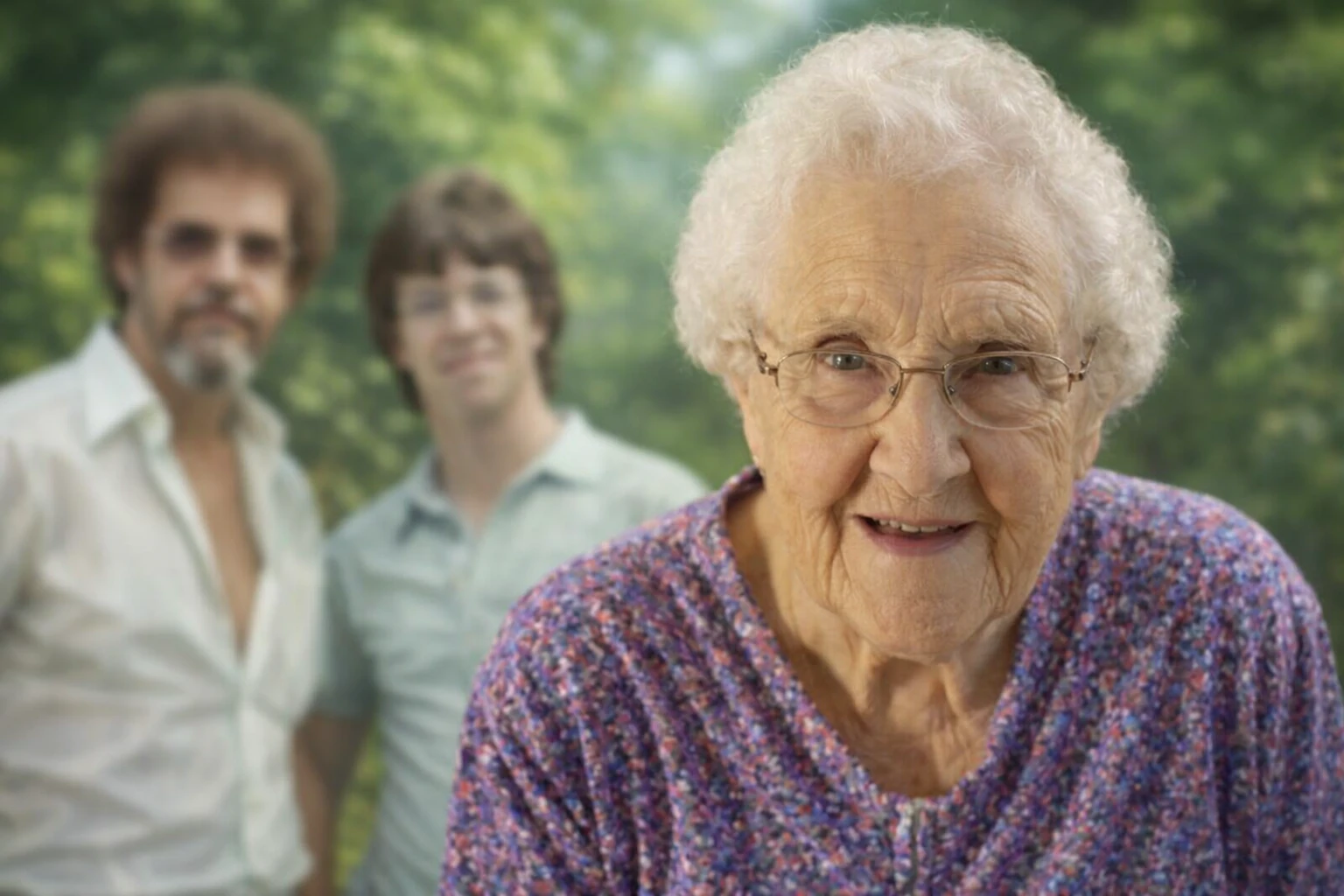
For millions of viewers, Bob Ross exists in a soft-lit television world of calm instruction, gentle encouragement, and “happy little trees.” His life, at least as it’s remembered, begins on screen. But long before public television made him a cultural icon, there was another life—less documented, more ordinary, and deeply private. Vivian Ridge belongs to that earlier chapter, a name that surfaces in biographies and search queries, but rarely in detail.
People arrive at her story looking for clarity, and often find something else: fragments, contradictions, and a surprising absence of firm record. What remains, when the noise is stripped away, is a quieter truth. Vivian Ridge was Bob Ross’s first wife and the mother of his only son, Steve Ross. Beyond that, her life is largely undocumented in reliable public sources, which says as much about the nature of privacy as it does about her place in history.
Early Life and Background
The public record offers very little that can be confidently verified about Vivian Ridge’s early life. Unlike figures who step into public careers or cultivate visibility, Ridge appears to have lived almost entirely outside the spotlight. There are no widely cited interviews, no institutional records easily accessible to the public, and no confirmed accounts that trace her upbringing in detail.
What’s known about her tends to come from indirect references, often tied to Bob Ross’s biography or Steve Ross’s later career. Some websites claim specific birthplaces or educational backgrounds, but these claims frequently conflict with one another and lack strong sourcing. That inconsistency suggests that much of the available information has been recycled rather than independently verified.
The absence of detail is not unusual for someone who lived outside celebrity culture. Many spouses of later-famous individuals leave behind only the outlines of a life—marriage, family, and a few dates—especially when their own work was not public-facing. In Ridge’s case, those outlines form the entirety of what can be responsibly reported.
Marriage to Bob Ross
Vivian Ridge’s place in the historical record begins most clearly with her marriage to Bob Ross. The two were married during Ross’s early adulthood, before he became widely known as a painter or television personality. At that time, Ross was building a very different life, one defined by military service rather than public recognition.
Bob Ross enlisted in the United States Air Force in 1960 and eventually rose to the rank of master sergeant. He spent a significant portion of his service years stationed in Alaska, where he first began painting seriously. It was during this period that his personal life took shape, including his marriage to Vivian Ridge.
The exact date of their marriage is not consistently documented in reliable sources. What can be said with confidence is that their relationship belonged to Ross’s formative years, when he was still far from the soft-spoken figure audiences would later recognize. Those who have studied his life often note that Ross described his military role as strict and demanding, a contrast to the gentle persona he later adopted on television.
Becoming a Mother: Steve Ross
One of the most concrete facts linking Vivian Ridge to the broader public narrative is the birth of her son, Robert Stephen “Steve” Ross. Steve was born on August 1, 1966, and would go on to become a painter and instructor in his own right, closely associated with his father’s legacy.
Steve Ross is perhaps the most visible connection between Vivian Ridge and the public. He appeared alongside Bob Ross on episodes of The Joy of Painting and later conducted workshops, teaching the same wet-on-wet technique that defined his father’s work. Through him, Ridge’s role in the family remains part of a living artistic tradition, even if her own life remains largely undocumented.
Accounts of Steve’s early years suggest a childhood shaped by both his father’s military career and his growing interest in painting. While detailed descriptions of Vivian Ridge’s role as a mother are scarce, it is clear that she was part of the family structure during this period, raising a son who would later step into the same creative space as his father.
The End of the Marriage
Public accounts generally agree that Vivian Ridge and Bob Ross’s marriage ended in divorce, with 1977 often cited as the year of their separation. Like many aspects of Ridge’s life, the details surrounding the divorce are not widely documented in reliable sources. There is little public discussion of the reasons behind the split, and neither Ross nor Ridge left a detailed record explaining the circumstances.
What is clear is the timing. The end of the marriage came before Bob Ross’s rise to national fame. The Joy of Painting premiered in 1982, several years after the reported divorce. That gap helps explain why Vivian Ridge is largely absent from the public-facing story of Bob Ross’s career.
Divorce, particularly before the era of constant media coverage, often left little trace in the historical record unless it involved public disputes or legal battles. In this case, the separation appears to have been handled privately, without the kind of documentation that would later feed biographies or media narratives.
Life Outside the Spotlight
One of the most striking aspects of Vivian Ridge’s story is how little of it intersects with public life. There is no evidence that she pursued a career that brought her into the media or into widely documented professional circles. Unlike some spouses of emerging public figures, she did not appear to participate in building a shared brand or public persona.
That absence has had a direct effect on how her story is told—or not told. Without interviews, published work, or public records tied to her own career, there is very little material for historians or journalists to draw from. The result is a biography that exists mostly in relation to others rather than as a standalone narrative.
Some websites attempt to fill this gap by describing Ridge as an artist or educator. However, these claims are not consistently supported by credible sources, and they often appear in contexts where verification is unclear. Without stronger evidence, it is more accurate to say that her professional life remains undocumented in reliable public records.
The Problem of Conflicting Information
Anyone who searches for Vivian Ridge quickly encounters a confusing mix of specific claims. Different sources list different birth dates, death dates, and life details, often with no clear indication of where the information originated. That inconsistency is one of the clearest signs that much of the material circulating online is not firmly grounded.
For example, some pages provide precise dates and locations for her birth, while others offer entirely different figures. Similar discrepancies appear in claims about her education, career, and later life. These contradictions are not minor variations; they point to a lack of verifiable documentation.
This creates a challenge for readers and writers alike. The demand for a complete biography is strong, but the evidence to support one is limited. Responsible reporting requires acknowledging that limitation rather than smoothing it over with unverified detail.
Vivian Ridge in the Context of Bob Ross’s Legacy
To understand why Vivian Ridge continues to attract attention, it helps to consider the enduring appeal of Bob Ross. Decades after his television series ended, Ross remains a cultural figure, known not only for his paintings but for his distinctive voice and philosophy. His image has been rediscovered by new generations through streaming platforms and social media.
In that context, every part of his life becomes a point of interest. Viewers want to know how he became who he was, and that curiosity extends to his relationships. Vivian Ridge represents the earliest chapter of his adult life, a time before the brand, before the fame, and before the carefully curated public persona.
That early chapter is harder to access, precisely because it was not lived in public. Ridge’s relative anonymity is not a gap waiting to be filled so much as a reflection of how different that period of Ross’s life was from what came later.
Steve Ross and the Continuing Connection
While Vivian Ridge herself remains largely out of view, her son has continued to carry forward a visible part of the Ross legacy. Steve Ross has taught painting workshops and made appearances that connect directly to his father’s work. For many fans, he represents continuity, a bridge between the original television series and its ongoing influence.
Through Steve, Vivian Ridge’s place in the story remains relevant. Even if her own biography is not widely documented, her role as his mother situates her within a family narrative that continues to evolve. That connection is one of the reasons her name continues to surface in searches and discussions.
At the same time, Steve Ross’s own public presence highlights the contrast between generations. Where Steve has appeared in media and engaged with audiences, Vivian Ridge seems to have remained private, leaving behind little more than the fact of her relationships.
Public Curiosity and Private Lives
The story of Vivian Ridge is, in many ways, a story about the limits of public knowledge. It reflects a broader tension between curiosity and privacy, especially in an era where information is expected to be readily available. Not every life leaves a detailed public record, and not every connection to fame produces a biography.
There is a tendency to treat missing information as something that can be reconstructed through inference or repetition. But here’s the thing: repetition does not create truth. When multiple sources repeat the same unverified claim, it can give the impression of certainty without actually providing it.
Ridge’s story resists that kind of reconstruction. What remains is a set of confirmed relationships and a timeline anchored to another person’s career, surrounded by a larger space that remains undocumented. That absence is part of the story, not a flaw to be corrected.
Frequently Asked Questions
Who was Vivian Ridge?
Vivian Ridge is best known as the first wife of painter and television host Bob Ross and the mother of his son, Steve Ross. Her identity in public records is primarily defined through these family connections rather than through a documented independent career.
Did Vivian Ridge have children?
Yes, she had one known child, Robert Stephen “Steve” Ross, born on August 1, 1966. Steve later became a painter and instructor, appearing on television with his father and continuing to teach art.
When did Vivian Ridge and Bob Ross divorce?
Most public accounts place their divorce around 1977. However, detailed documentation about the separation is limited, and the reasons behind it have not been widely reported.
Was Vivian Ridge an artist?
Some online sources describe her as an artist or teacher, but these claims are not consistently supported by reliable evidence. There is no widely verified record of her professional work in the arts.
What happened to Vivian Ridge later in life?
There is no clear, widely verified public record detailing her later life or death. Conflicting claims exist online, but they lack consistent sourcing and should be treated with caution.
Why is there so little information about Vivian Ridge?
Vivian Ridge appears to have lived a private life outside the public eye. Unlike Bob Ross, she did not have a media presence, which has resulted in a limited historical record.
Conclusion
Vivian Ridge’s biography is defined as much by what is unknown as by what is known. She stands at the edge of a famous story, connected to one of the most recognizable figures in American television, yet largely absent from the record that surrounds him. That absence is not unusual, but it is often misunderstood.
Her life reminds us that not every person linked to fame becomes part of its narrative. Some remain outside it, even as their names continue to appear in search results and casual references. Ridge’s role as Bob Ross’s first wife and Steve Ross’s mother is clear, but the details of her own life remain largely private.
There is a kind of honesty in that limitation. Rather than forcing a complete story where one does not exist, it is more accurate to recognize the boundaries of the available evidence. Vivian Ridge may not have left behind a detailed public biography, but her place in a well-known family story ensures that she will continue to be remembered—even if only in outline.
