
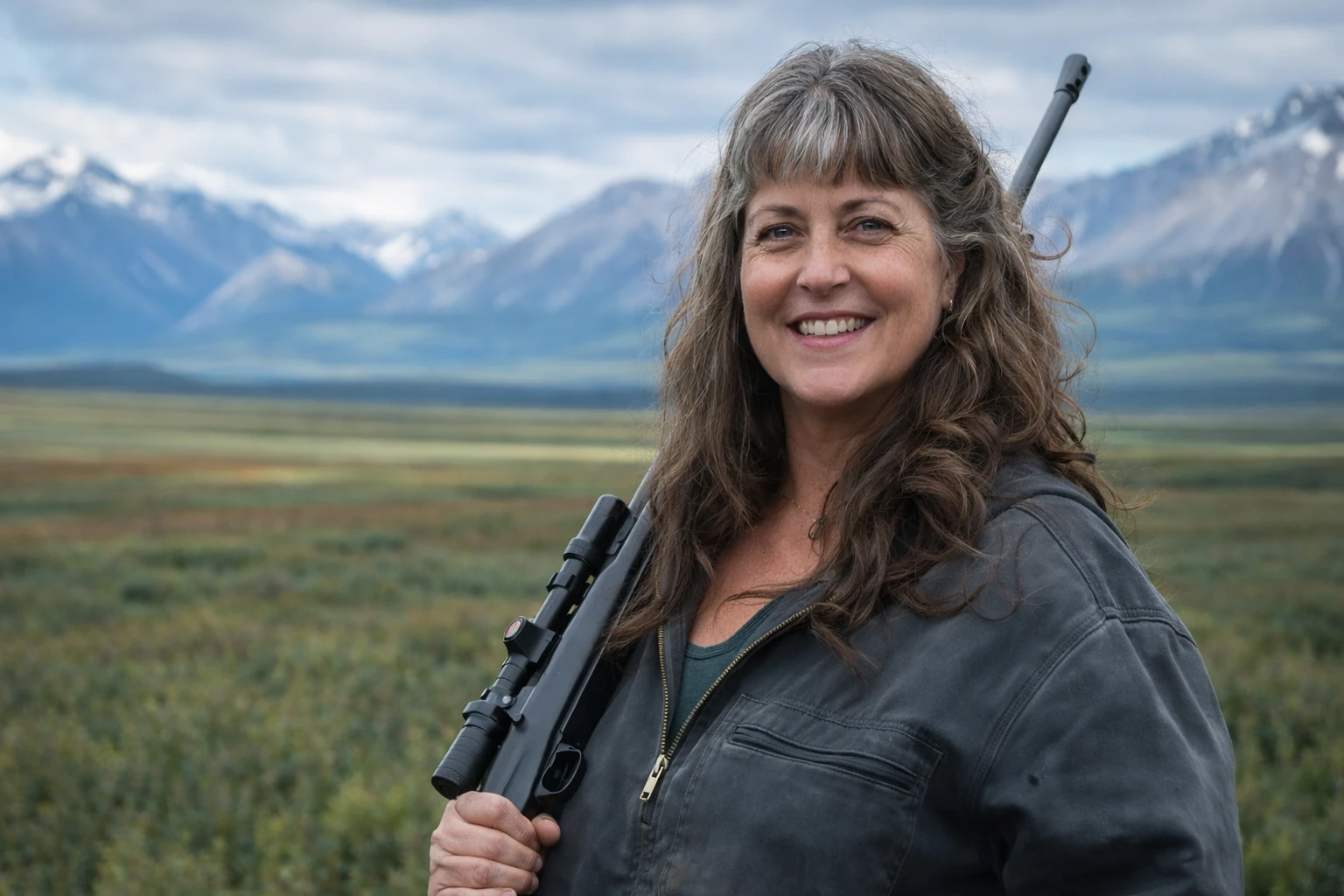
Long before cameras arrived in northern Alaska, Sue Aikens was already living a life that most people would struggle to imagine, let alone sustain. Winters dropped well below zero. Supplies came in by plane. The nearest help could be hundreds of miles away. For Aikens, this wasn’t an experiment or a phase. It was simply how she lived.
That reality is what eventually made her one of the defining figures of Life Below Zero, National Geographic’s long-running series about survival in remote Alaska. But television fame came late, and it never fully defined her. Aikens was not built for performance. She was built for endurance, shaped by a life that had demanded resilience long before anyone was watching.
Early Life and Family Background
Sue Aikens was born on July 1, 1963, in Chicago, Illinois, according to widely cited public records such as IMDb. Her early years were far removed from the frozen wilderness that would later define her public identity. She grew up in a more conventional environment, but her childhood was marked by instability that she has alluded to in interviews over the years.
Her mother played a central role in shaping the course of her life. At one point during her youth, Aikens moved to Alaska with her mother, a decision that would quietly set the trajectory for everything that followed. While many people relocate to Alaska seeking adventure or opportunity, Aikens’s introduction to the state was less romantic and more circumstantial.
What’s striking is how early she adapted to difficult conditions. Alaska, even in its more populated regions, demands a certain level of independence. For Aikens, those demands didn’t just build skills; they reinforced a mindset. She has described learning early on that survival wasn’t abstract. It was practical, daily, and often unforgiving.
Her formal education is not extensively documented in public records, and she has never positioned herself as someone shaped by academic pathways. Instead, her story is one of lived experience, where knowledge came from necessity rather than classroom instruction.
Finding Her Place in Alaska
Aikens did not become the person viewers recognize overnight. Her life in Alaska evolved gradually, shaped by work, relationships, and long stretches of trial and error. Over time, she moved further away from populated areas and deeper into the kind of isolation that would later define her.
The turning point came when she became associated with Kavik River Camp, a remote outpost located near the Arctic National Wildlife Refuge. The camp sits far north of Fairbanks, accessible primarily by air, and operates in conditions that can quickly turn dangerous. It was not designed as a retreat from modern life, but as a functional base for hunters, researchers, and travelers navigating the Arctic.
Aikens eventually took over operations at Kavik, becoming its long-time operator. Running the camp required far more than basic survival skills. It meant managing fuel, maintaining equipment, coordinating flights, and ensuring that guests could safely arrive and depart. It also meant enduring months of isolation, especially during the harshest parts of winter.
Not many people know this, but Kavik River Camp is not a solitary cabin but a working facility. That distinction matters. Aikens’s life was never just about surviving alone in the wilderness. It was about keeping a remote business operational in one of the most challenging environments in North America.
The Reality Behind Kavik River Camp
Life at Kavik River Camp is often misunderstood by those who encounter it through television clips or short online features. The camp’s location near the Arctic National Wildlife Refuge places it in an environment where logistics dominate daily life. Everything from food to fuel must be flown in, and delays can have serious consequences.
Aikens’s role at Kavik has been part survivalist, part manager, and part host. Visitors to the camp have included hunters, scientists, photographers, and film crews. Each group arrives with different expectations, but all depend on the camp’s infrastructure and Aikens’s experience to navigate the region safely.
The environment itself is not forgiving. Temperatures can drop far below freezing for extended periods, and weather conditions can ground flights without warning. Wildlife, including bears and wolves, adds another layer of unpredictability. In this setting, mistakes are not easily corrected.
What’s surprising is how much of Aikens’s work involves routine rather than drama. Maintaining generators, managing supplies, and preparing for incoming guests require constant attention. These tasks rarely make headlines, but they form the backbone of her life. Without them, the camp would not function.
The Breakthrough: Life Below Zero
Aikens’s life might have remained largely unknown outside Alaska if not for Life Below Zero. The National Geographic series premiered in 2013 and focused on individuals living in remote parts of the state. Aikens quickly became one of its most recognizable figures.
Her appeal was immediate. Unlike some reality television personalities, Aikens did not present a polished or carefully curated image. She spoke directly, often with blunt humor, and did not shy away from describing the difficulties of her environment. That honesty resonated with viewers.
The show itself gained critical recognition, including multiple Emmy Awards for cinematography and editing. These honors reflected the technical skill involved in capturing life in such extreme conditions. But for many viewers, Aikens was the emotional center of the series.
Here’s where it gets interesting. While the show brought her widespread attention, it did not fundamentally change her daily life. She continued to run Kavik River Camp, dealing with the same challenges she had always faced. The cameras documented her reality; they did not create it.
Personal Life and Relationships
Sue Aikens has been married more than once, though details about her relationships are not always fully documented in reliable public sources. She has spoken in general terms about past marriages, including the challenges of maintaining relationships while living in such a remote environment.
She is also a mother, though she tends to keep details about her children private. This is consistent with how she approaches much of her personal life. While she is open about her experiences in Alaska, she does not frequently share intimate family details in public.
The truth is, her lifestyle has shaped her relationships as much as anything else. Living in isolation for extended periods can strain even the strongest partnerships. For Aikens, independence has often taken precedence, not out of preference but necessity.
Her public image reflects this balance. She is seen as fiercely self-reliant, but also aware of the personal costs that come with that level of independence. It is a tension that adds depth to her story and helps explain why she has remained compelling to audiences.
The Bear Attack and Other Dangers
One of the most widely discussed events in Aikens’s life is her encounter with a grizzly bear. She has described being attacked near Kavik River Camp and sustaining serious injuries. The story has been retold in various forms across media, sometimes with added drama that can be difficult to verify.
What can be said with confidence is that the attack became part of her public narrative. It reinforced the risks associated with her lifestyle and underscored the reality that living in such an environment carries real danger.
But the bear attack is only one example. Daily life at Kavik involves a range of hazards, from extreme cold to equipment failures. Aikens has also spoken about accidents and injuries that occur simply from working in such a demanding setting.
These experiences are not presented as heroic moments. Instead, they are treated as part of the job. That perspective is one of the reasons her story feels grounded rather than exaggerated.
The Lawsuit Against Producers
In 2017, Aikens filed a lawsuit related to Life Below Zero, alleging that producers placed her in unsafe situations during filming. According to reporting at the time, she claimed she had been injured in a snowmachine accident that occurred under circumstances she believed were avoidable.
The case drew attention because it raised questions about safety in reality television. Productions that operate in extreme environments face unique challenges, and Aikens’s claims highlighted the tension between storytelling and risk.
However, the lawsuit did not proceed to a full trial. Reports later indicated that it was dismissed for procedural reasons, specifically related to service. That outcome means the underlying claims were not fully tested in court.
That said, the episode remains an important part of her story. It shows that Aikens was willing to challenge the conditions of a production that had brought her fame, reflecting her broader approach to life: direct, unfiltered, and unwilling to accept unnecessary risk.
Income, Business, and Net Worth
Estimating Sue Aikens’s net worth is difficult, and figures often cited online vary widely. Most credible discussions describe her wealth as modest compared to mainstream television celebrities. Her income has likely come from a combination of television work and operating Kavik River Camp.
Running a remote camp is not a simple or inexpensive business. Costs include transportation, maintenance, fuel, and staffing when necessary. Revenue depends on seasonal demand and the types of clients visiting the camp.
Television exposure likely increased interest in Kavik, but it also brought new expectations and logistical challenges. Aikens’s financial picture is best understood as tied to both her business operations and her role on Life Below Zero.
Any specific net worth figures should be treated as estimates rather than confirmed facts. Aikens herself has not publicly disclosed detailed financial information, and the available data does not support precise calculations.
Public Image and Cultural Impact
Aikens occupies a unique space in popular culture. She is not a traditional celebrity, nor is she a typical reality television figure. Instead, she represents a version of independence that feels both authentic and rare.
Her appeal cuts across different audiences. Some viewers are drawn to the survival aspect of her story, while others connect with her personality and perspective. She does not present her life as something others should emulate, which makes it more believable.
There is also a broader cultural context. Interest in off-grid living and self-sufficiency has grown in recent years, and Aikens’s story fits into that trend. But she stands apart because her lifestyle is not a trend or a choice made for aesthetic reasons. It is a long-term commitment shaped by necessity.
Her presence on Life Below Zero helped bring that reality into mainstream awareness. Even for viewers who never intend to visit Alaska, her story offers a glimpse into a way of life that remains largely outside modern urban experience.
Where Sue Aikens Is Now
As of the most recent public information, Sue Aikens remains associated with Kavik River Camp. The camp continues to operate, and she is still linked to its day-to-day activities. This continuity is significant because it shows that her life has not been fundamentally altered by television fame.
Recent reporting has suggested that Life Below Zero may have concluded its run after many successful seasons. If that is the case, Aikens’s public visibility may shift, but her core work remains unchanged.
The truth is, her life has always existed beyond the show. Television brought attention, but it did not define her purpose. She continues to live and work in an environment that demands resilience, regardless of whether cameras are present.
Frequently Asked Questions
Who is Sue Aikens?
Sue Aikens is an Alaskan camp operator and television personality best known for her role on Life Below Zero. She runs Kavik River Camp, a remote outpost near the Arctic National Wildlife Refuge. Her life in extreme conditions made her one of the most recognizable figures on the show.
Where does Sue Aikens live?
Aikens lives at or near Kavik River Camp in northern Alaska. The camp is located in a remote area accessible primarily by air. Its isolation is a defining feature of both her life and her public image.
Is Sue Aikens still on television?
Reports indicate that Life Below Zero has ended after a long run, though past episodes remain available. Aikens’s television presence may continue through interviews or related content, but her primary work remains at Kavik.
What happened to Sue Aikens and the bear attack?
Sue Aikens has spoken publicly about surviving a grizzly bear attack. While details vary across retellings, the event is widely accepted as part of her history and highlights the risks of living in such a remote environment.
Is Sue Aikens married?
Aikens has been married in the past, but she tends to keep details about her personal relationships private. Public information about her current relationship status is limited and not always consistently reported.
What is Sue Aikens’s net worth?
Her net worth is not publicly confirmed and is generally described as an estimate. Her income has come from both her television work and her role as the operator of Kavik River Camp.
Conclusion
Sue Aikens’s story stands out because it resists easy categorization. She is neither a traditional celebrity nor a simple survivalist figure. Instead, she represents a life built on endurance, shaped by circumstances that most people will never face.
Her time on Life Below Zero brought her into public view, but it did not create the person audiences came to know. That person was already there, managing a remote camp and navigating the challenges of Arctic life long before the first episode aired.
What remains most compelling is her consistency. Through danger, public attention, and personal challenges, Aikens has continued to live on her own terms. That choice, more than any single event, defines her legacy.
And even as television fades from the picture, the essential fact remains unchanged. Sue Aikens is still out there, keeping the lights on in a place where few people would last a season, let alone a lifetime.
