
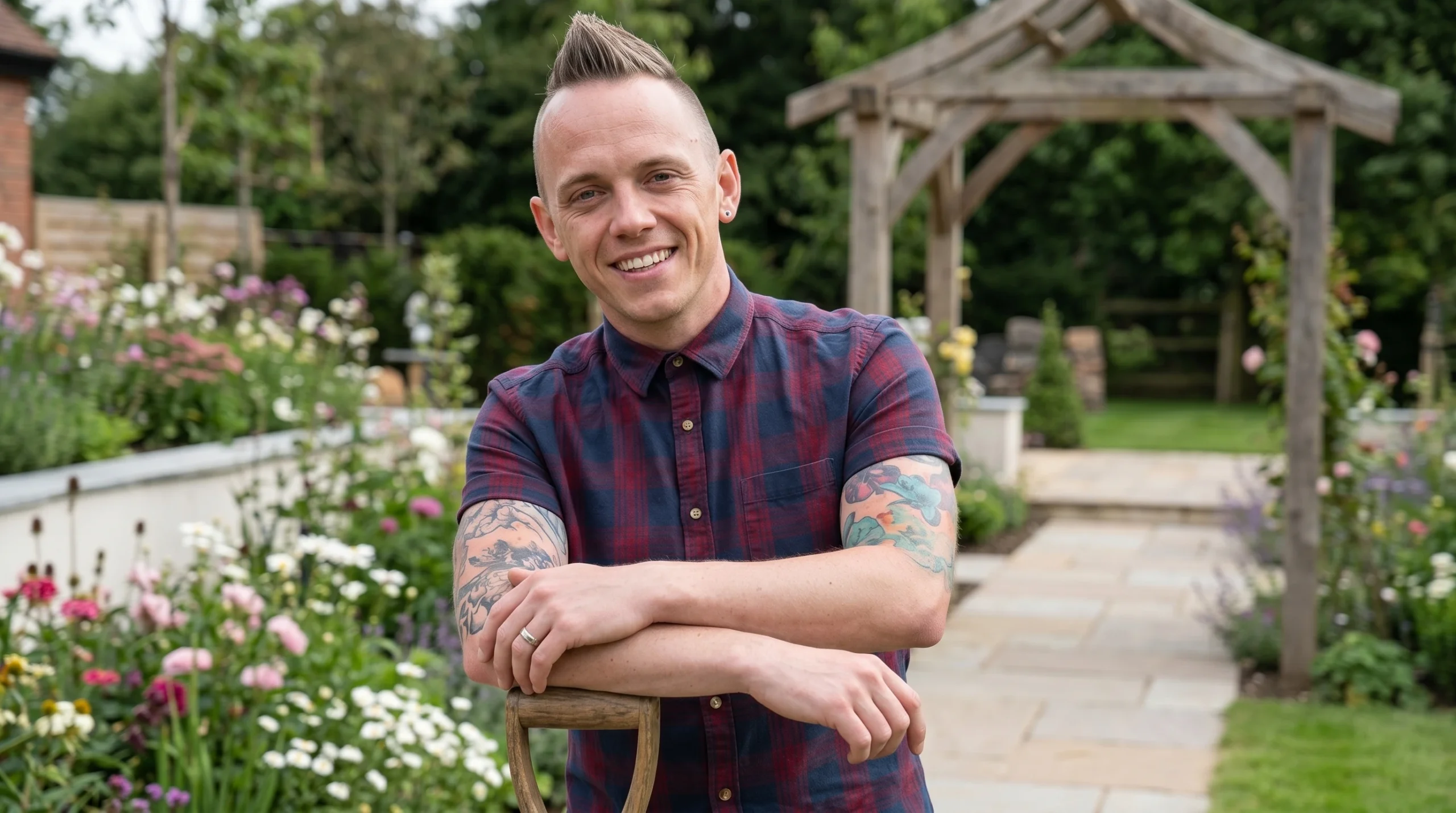
Lee Burkhill built his public life around gardens, but the personal story that many viewers search for begins away from television, away from show borders, and away from the clipped rhythm of BBC makeover formats. Before he became known as Garden Ninja, Burkhill spent years in a high-pressure IT career that looked stable from the outside and felt increasingly wrong from the inside. The person he has credited with helping him face that truth is his husband, a private figure who appears rarely in public accounts but matters deeply to the shape of Burkhill’s life.
That is why the search for “Lee Burkhill husband” is both understandable and easy to mishandle. Fans of Garden Rescue want to know who stands beside the designer whose personality has made him one of British gardening television’s most memorable newer faces. The honest answer is that Burkhill is married, he has publicly referred to his husband, and he has described him as an important voice during a major career change. Beyond that, Burkhill has kept the marriage largely private, which is itself an important part of the story.
Who Is Lee Burkhill?
Lee Burkhill is a British garden designer, television presenter, writer, vlogger, and horticulture educator best known by the name Garden Ninja. He became widely familiar to daytime television viewers through BBC One’s Garden Rescue, where designers compete to create outdoor spaces for homeowners with real budgets and practical needs. His appeal comes from a mix of technical knowledge, direct advice, and a personal style that makes gardening feel less formal than it can sometimes appear.
Burkhill’s public brand is built around clarity. He explains soil, planting, pruning, borders, wildlife gardening, and garden design in plain language, often for people who feel locked out of horticulture by jargon or cost. That accessibility has helped him build an audience beyond traditional gardening circles. He is not simply a TV personality who happens to talk about plants; his profile rests on years of design work, public teaching, and a career change that gave his story emotional weight.
His professional identity also carries a strong sense of reinvention. Before full-time garden design, Burkhill worked for more than a decade in IT project management, a field that gave him structure, pressure, and corporate progression but not the deeper satisfaction he wanted. He has described the move into horticulture as a deliberate choice rather than a convenient leap into television. That decision, by his own account, was encouraged at home by the man he calls his husband.
The Short Answer About Lee Burkhill’s Husband
Lee Burkhill is married and has publicly spoken about his husband in interviews. The most meaningful detail he has shared is that his husband encouraged him to reconsider his career when he was unhappy in IT. That encouragement helped push Burkhill toward garden design training, including study connected with RHS Harlow Carr, and eventually toward the professional life that made him known as Garden Ninja.
The identity and private life of Burkhill’s husband are not broadly documented in strong public sources. Some online articles attach a name to him, but Burkhill himself has not made his spouse a recurring public figure in the way some television personalities do. For that reason, the responsible approach is to say what can be verified: Burkhill has a husband, he has spoken about his support, and he has chosen not to turn the marriage into content.
That boundary should not be treated as a mystery to solve. A public figure’s spouse does not automatically become a public figure, especially when the spouse does not appear to seek attention. Burkhill’s husband matters because he was part of a turning point in Burkhill’s life, not because readers are entitled to every private detail. The marriage gives context to the man, but it does not need to become a public file.
Early Life and Family Influences
Burkhill’s love of gardening did not begin with television or design school. He has spoken about childhood connections to plants, family gardening, and the sense of calm that came from being outdoors. His grandfather’s allotment and rose garden have been part of that remembered background, giving him an early model of gardening as both practical work and emotional refuge. Those details help explain why horticulture later felt less like a new identity than a return to something already planted.
Growing up, Burkhill found gardens to be places of safety and focus. He has described gardening as a way to switch off during difficult periods, including the kind of school years that can leave lasting marks on a young person. That experience helps explain the empathy in his later work, especially his interest in gardens as spaces people actually live in rather than spaces designed only to impress. His public advice often carries that same thread: a garden should support the person using it.
There is also a democratic streak in the way he talks about gardening. Burkhill does not present horticulture as a club reserved for those with inherited knowledge or large country gardens. His work often speaks to people with new-build plots, small lawns, awkward borders, limited budgets, or no confidence. That instinct, shaped by his own route into the field, is one reason his career story resonates beyond plant enthusiasts.
Education, Early Ambitions, and the IT Years
Before gardening became his profession, Burkhill built a career in IT project management. The job gave him a serious professional background and the kind of discipline that later proved useful in design work. Garden design may look soft and instinctive from the outside, but real projects require planning, budgets, schedules, problem-solving, and calm communication with clients. In that sense, the IT years were not wasted, even if they were not where he wanted to remain.
The problem was not that Burkhill lacked success in his first career. By his own telling, the work became more stressful as he moved higher, and the emotional cost began to outweigh the comfort of stability. Many people recognize that pattern: the promotion that looks good, the salary that makes leaving harder, and the private feeling that life is being spent in the wrong room. Burkhill’s later success makes the move look obvious, but at the time it would have involved risk.
Here’s where his husband becomes central to the biography. Burkhill has said that his husband told him he needed to find something he cared about, a comment that seems to have landed at the right moment. It was not a magic solution, and it did not replace study, work, or professional credibility. But it gave voice to something Burkhill already knew and helped him begin acting on it.
Marriage and the Private Life He Protects
The public knows Lee Burkhill as an openly gay married man, but not as someone who has placed his marriage at the center of his media identity. That distinction matters. He has never hidden the existence of his husband in the sources where the subject comes up, yet he has not made his spouse part of a promotional brand. The result is a rare kind of balance: visible enough to be honest, private enough to remain personal.
For readers, that can feel frustrating because search culture encourages complete answers. People type “Lee Burkhill husband” expecting a name, a timeline, a wedding story, perhaps children, perhaps a home-life profile. What they find instead is a limited public record. That does not mean there is a scandal or an omission; it means Burkhill has drawn a line around domestic life.
A respectful biography should honor that line. Burkhill’s marriage belongs in the story because he has connected it to his career change and because it helps readers understand the support behind his public path. It should not be stretched into speculation about private routines, finances, family plans, or domestic arrangements. The known facts are enough to say something meaningful without pretending to know everything.
The Career Change That Defined Him
After deciding that IT was no longer the right future, Burkhill moved into garden design with seriousness. He trained, studied, volunteered, and built the skills needed to work professionally rather than simply calling himself a designer because he loved plants. That distinction matters in horticulture, where enthusiasm is common but good design requires structure, plant knowledge, proportion, drainage awareness, soil understanding, and client management. Burkhill’s later work reflects both creative instinct and project discipline.
His Garden Ninja identity gave him a clear public platform. The name is memorable, slightly playful, and direct enough to stand out in a crowded gardening media field. Under that brand, Burkhill created written guides, videos, design advice, and public-facing teaching aimed at making gardening less intimidating. It also gave him a way to translate professional expertise for ordinary homeowners who wanted useful help rather than lofty design theory.
The move into gardening was not just a change of job title. It was a change in how Burkhill spent his days, how he used his energy, and how he related to other people. His husband’s encouragement belongs here because it marks the emotional hinge of the story. Without over-romanticizing it, the marriage appears to have offered the kind of honest support that allows a person to admit a comfortable life is not always a fulfilled one.
Garden Ninja and the Rise of a Public Profile
Garden Ninja became more than a nickname. It developed into a public identity built around garden design, horticultural education, online content, and practical problem-solving. Burkhill’s website and videos have covered subjects ranging from border planning to pruning, wildlife-friendly gardening, soil improvement, planting design, garden mistakes, and budget-conscious transformations. The tone is usually energetic, straight-talking, and aimed at helping viewers take action.
That public teaching style has been central to his growth. Many gardening experts speak beautifully to people who already know the basics, but Burkhill often starts where beginners actually are. He explains why a plant fails, why a lawn struggles, why a border looks flat, or why a garden feels disconnected from the house. That ability to diagnose common problems made him a natural fit for television, where viewers need quick clarity and credible advice.
His awards and professional recognition also helped build authority. Burkhill has been associated with RHS-linked achievement, garden media recognition, and show-garden or trade-stand honors. Those markers gave the Garden Ninja brand more weight than a social media persona alone could provide. They showed that he was not only accessible, but also respected within the gardening world.
Joining Garden Rescue
Burkhill’s arrival on Garden Rescue introduced him to viewers who may not have known his online work. The BBC format places designers in a practical contest, asking them to respond to homeowners’ wishes, budgets, personalities, and outdoor limitations. It is a useful stage for a designer like Burkhill because it rewards communication as much as artistic taste. The audience needs to understand not only what he proposes, but why it works.
On screen, Burkhill brought a sharper-edged visual identity than many traditional gardening presenters. The bleached hair, tattoos, bold styling, and Garden Ninja name made him instantly recognizable. But the look would have meant little without the ability to produce workable ideas under pressure. His television appeal rests on the combination of personality and competence.
Garden Rescue also widened the audience for his personal story. Viewers who meet a presenter through repeated episodes often become curious about the life behind the work. That is where searches about his husband, age, background, net worth, and family tend to begin. Burkhill’s case shows the strange bargain of television visibility: public affection grows, but so does interest in details the person may not want to share.
Public Image and LGBTQ+ Visibility
Burkhill’s public image is not built solely around being gay, but his visibility as an openly gay married man in gardening media has meaning. Horticulture on television has often leaned traditional, gentle, and familiar, which can make difference stand out even when the work itself is the main point. Burkhill has shown that a gardening presenter can be technically serious, visually distinctive, outspoken, and still deeply connected to the craft. That presence matters to viewers who rarely see themselves reflected in garden media.
He has also been publicly associated with support for LGBTQ+ people, including trans people. That support fits with his broader story of having used gardening as a refuge and later as a public language of care, creativity, and confidence. He has spoken about bullying and the emotional marks left by growing up gay in less accepting spaces. Those experiences add depth to his public warmth because they show that confidence was earned, not simply performed.
The truth is, visibility works best when it is allowed to be ordinary. Burkhill’s marriage does not need to be presented as a spectacle to matter. The fact that he can be a married gay man on mainstream gardening television, while also being judged by his design work and teaching, is part of a wider cultural shift. It is quiet progress, but it is still progress.
Career Achievements and Industry Standing
Burkhill’s industry standing comes from several overlapping roles. He is a designer, presenter, writer, video educator, and public gardening voice. That mix is increasingly common in modern horticulture, where professionals often need to move between client work, media, social platforms, and public teaching. Burkhill has managed that shift with a brand that feels consistent across those spaces.
His work often centers on helping people understand why design choices matter. A garden is not only a collection of plants; it is movement, sightlines, texture, light, soil, structure, maintenance, and mood. Burkhill’s strength lies in translating those ideas into advice that ordinary homeowners can use. He tends to frame design as problem-solving rather than decoration, which is one reason his content has practical staying power.
Television made him more recognizable, but his career does not depend only on television. The Garden Ninja platform gives him an independent audience, and his design background gives him credibility beyond broadcasting. That matters because TV careers can change quickly, while a strong professional base gives a public figure more control. Burkhill’s public life looks strongest when seen as a combination of craft, media skill, and personal reinvention.
Net Worth, Income Sources, and Money Questions
Readers often search for Lee Burkhill’s net worth, but there is no reliable public figure that can be treated as confirmed. Online estimates should be viewed cautiously because they often rely on guesses about television pay, web traffic, sponsorship, and business income. Burkhill has not publicly released personal financial accounts in a way that would allow a precise calculation. Any exact figure presented without strong sourcing should be treated as an estimate at best.
His income likely comes from several professional streams. These may include garden design services, television work, digital content, writing, online courses, public appearances, brand partnerships, and related horticultural projects. That kind of mixed income is common for modern media professionals who also run specialist businesses. It can be meaningful without being easy to measure from the outside.
What can be said with confidence is that Burkhill has built a viable public-facing career from expertise rather than from fame alone. His value lies in knowledge, presentation, design skill, and audience trust. Those assets do not translate neatly into a published net worth figure, but they explain why he has remained visible. In this case, the money question is less useful than the career structure behind it.
Misunderstandings About Lee Burkhill’s Husband
One common misunderstanding is that Burkhill’s privacy means there is hidden drama around his marriage. There is no solid reason to believe that. The simpler and more respectful explanation is that he shares what he wants to share and keeps the rest offline. Many public figures do the same, especially when a spouse has not chosen a public career.
Another misunderstanding is that every detail repeated on biography sites is confirmed. That is not how public information works. A claim may appear in several places because one site copied another, not because each site verified it independently. With Burkhill’s husband, the strongest confirmed point remains the relationship and the support he gave during Burkhill’s career change.
There is also a tendency to make the husband the answer to Burkhill’s success. That would be unfair to both men. His husband may have encouraged him at a decisive moment, but Burkhill built the career through study, work, risk, and persistence. Support can open a door, but the person still has to walk through it and keep going.
Where Lee Burkhill Is Now
Lee Burkhill remains active as Garden Ninja, with a public profile that spans design advice, television recognition, online education, and gardening media. His work continues to speak to people who want attractive outdoor spaces without feeling overwhelmed by horticultural language. The core of his appeal has not changed: he makes gardens feel possible. That is a powerful thing in a field that can sometimes make beginners feel foolish.
His marriage remains part of the background rather than the foreground. Burkhill has shared enough for readers to understand that his husband was important in his journey, but not so much that the relationship becomes public property. That choice fits the tone of his wider career, which is open about identity and experience while still holding personal boundaries. It is a grown-up way to live in public.
For fans, the best way to understand him is to keep both truths together. Lee Burkhill is a married man whose husband helped him recognize the need for change, and he is also a skilled professional who turned that change into a respected gardening career. The private support matters, but the public work is what made him known. The story is strongest when neither side is exaggerated.
Frequently Asked Questions
Is Lee Burkhill married?
Yes, Lee Burkhill is married and has publicly referred to his husband. He has spoken about his husband in connection with the career change that took him from IT project management into garden design. The marriage is part of his public biography, but Burkhill has not made it a constant subject of media attention.
Who is Lee Burkhill’s husband?
Lee Burkhill’s husband is a private figure, and Burkhill has not widely publicized detailed personal information about him in official profiles or major public interviews. Some secondary sites attach a name to him, but the strongest public information is limited. The safest answer is that Burkhill has a husband who supported his move into gardening, while many further details remain private.
Did Lee Burkhill’s husband help his career change?
Yes, Burkhill has credited his husband with encouraging him when he was unhappy in his IT career. That encouragement helped him consider work he cared about more deeply and led him toward garden design training. It was not the whole story, but it appears to have been an important emotional turning point.
Does Lee Burkhill have children?
There is no strong public information confirming that Lee Burkhill has children. Burkhill’s public profiles focus mainly on his gardening career, television work, design services, health, dogs, and professional interests. Because he keeps much of his home life private, it would be irresponsible to make claims about children without clear confirmation.
What did Lee Burkhill do before Garden Rescue?
Before Garden Rescue, Burkhill worked for more than a decade in IT project management. He later trained in garden design and built the Garden Ninja brand through design work, writing, video content, and public teaching. His television career grew from that professional base rather than appearing from nowhere.
Is Lee Burkhill still on Garden Rescue?
Lee Burkhill is strongly associated with Garden Rescue after joining the BBC gardening series as one of its designers. Television lineups can change from season to season, so viewers should check current BBC listings for the latest episode appearances. His wider Garden Ninja work continues beyond any single programme.
What is Lee Burkhill’s net worth?
There is no verified public net worth figure for Lee Burkhill. Online estimates should be treated with caution because they are usually based on incomplete assumptions about TV fees, business income, web revenue, and sponsorship. His known income sources are more likely tied to garden design, media work, online content, teaching, and related horticultural projects.
Conclusion
Lee Burkhill’s husband is an important part of his story, but not because the public knows every detail about him. He matters because Burkhill has described him as the person who helped him face a hard truth: the secure career he had built was not the life he wanted to keep living. That moment of encouragement helped shape a path that eventually led to Garden Ninja and national television.
The more interesting biography is not a gossip story about a private spouse. It is a story about support, timing, and the courage to change direction before comfort becomes a trap. Burkhill took an early love of gardening, added training and discipline, and turned it into a public career with real authority. His husband’s presence in that story gives it warmth without needing to give away the couple’s private life.
That balance is part of why Burkhill’s public image works. He is open enough to be relatable, skilled enough to be trusted, and private enough to remain grounded. For readers searching “Lee Burkhill husband,” the answer is clear but intentionally limited: he is married, his husband helped encourage a life-changing career move, and the rest belongs to them.
