
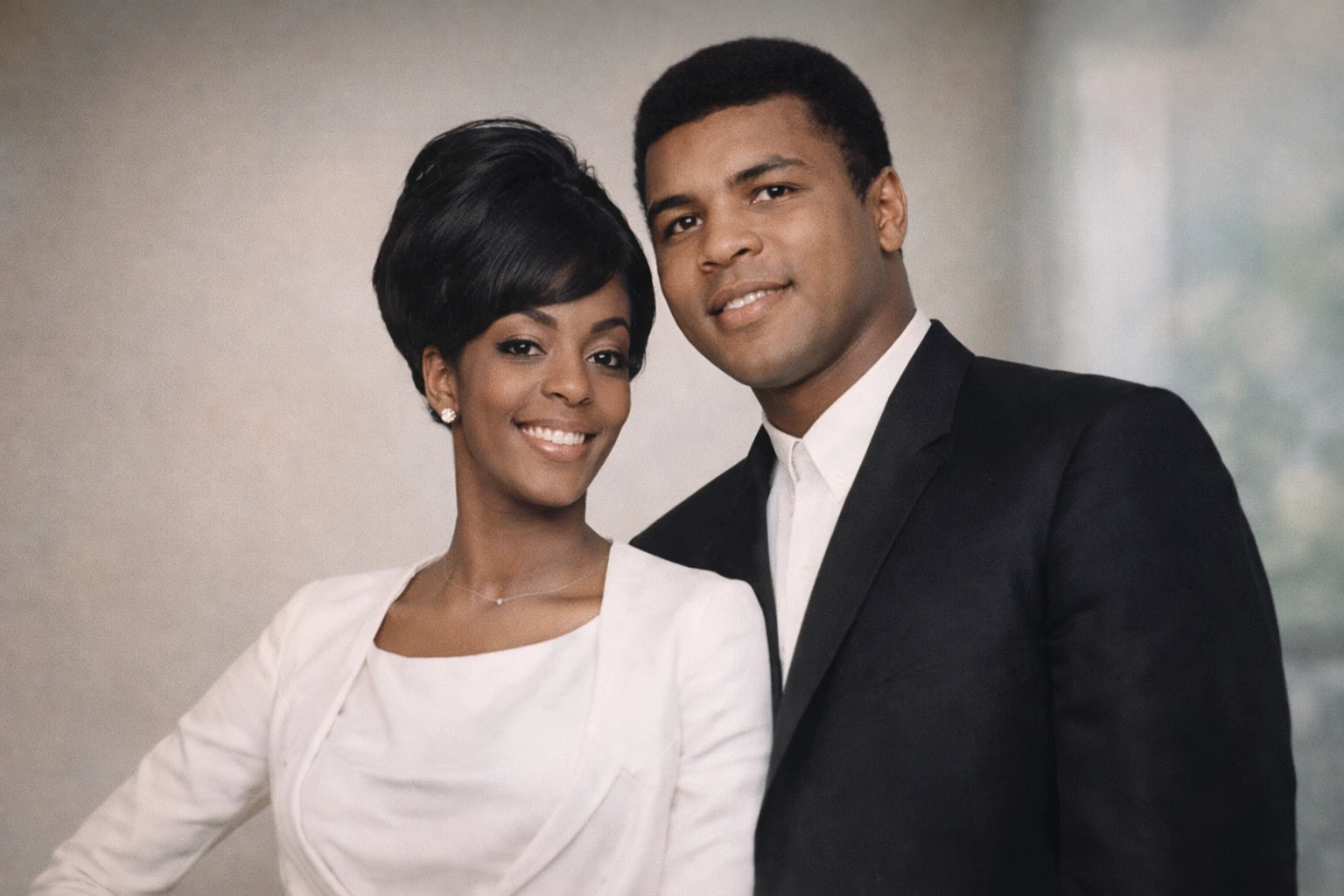
Few people enter the public record as suddenly—and as briefly—as Sonji Roi did. In the summer of 1964, she went from relative anonymity to being the wife of the most famous boxer in the world, Muhammad Ali, then still widely known as Cassius Clay. Their marriage lasted barely a year, yet it unfolded at a moment when Ali himself was redefining his identity, his beliefs, and his place in American culture. That collision—between a fast-moving personal relationship and a man undergoing a profound public transformation—has kept Sonji Roi’s name alive long after the marriage ended.
Her story is often told in fragments. Some accounts reduce her to a footnote in Ali’s life, while others fill the gaps with speculation. The truth sits somewhere in between. What can be confirmed is compelling enough: a whirlwind romance, a deeply strained marriage shaped by religion and expectation, a brief attempt at a music career, and a life that receded from the spotlight long before her death in 2005. What remains less clear are many of the personal details that would normally define a biography, including parts of her early life and even her exact age.
Early Life and Background
Sonji Roi’s early life is one of the least documented aspects of her biography. Most widely circulated accounts describe her as being from Chicago, Illinois, and that aligns with later records placing her back in the city after her marriage ended. However, even basic details such as her birth date vary across sources, with estimates generally placing her birth in the mid-1940s. Some records suggest November 1945, others point to a slightly later year, and contemporaneous reporting occasionally contradicts both.
That lack of clarity is not unusual for someone who became known primarily through association with a public figure rather than through a long-standing career in the public eye. Before meeting Muhammad Ali, Sonji Roi was described as a cocktail waitress and a model. These were common paths for young women seeking independence and visibility in mid-century urban America, especially in cities like Chicago where nightlife and entertainment offered both opportunity and risk.
What stands out in the limited descriptions of her early personality is a consistent theme. People who knew her later described her as independent, spirited, and resistant to being controlled. These traits would become central to the story of her marriage and its eventual breakdown.
Meeting Muhammad Ali
Sonji Roi met Muhammad Ali in July 1964, just months after he had defeated Sonny Liston to become heavyweight champion of the world. At that point, Ali was already a global figure, but he was also in the middle of a personal transformation that would soon reshape his public identity. He had aligned himself with the Nation of Islam and was beginning to distance himself from the name Cassius Clay.
Accounts of their first meeting are consistent in one respect: the speed of what followed. Sonji later recalled that Ali proposed marriage the very night they met. Whether that moment unfolded exactly as remembered, the timeline that followed is clear. They were married on August 14, 1964, in Gary, Indiana—just over a month after their introduction.
The marriage was not just a private union. It placed Sonji Roi directly into the center of a rapidly intensifying public narrative. Ali was no longer simply a champion athlete; he was becoming a political and cultural figure, challenging norms about race, religion, and identity in America. Anyone close to him would inevitably be drawn into that orbit.
A Marriage Under Pressure
From the beginning, the marriage carried tensions that went far beyond ordinary newlywed adjustment. Ali’s commitment to the Nation of Islam came with expectations about behavior, dress, and daily life. These expectations were particularly strict for women, emphasizing modesty and adherence to religious codes that Sonji Roi had not been raised to follow.
Reports from the time and later recollections suggest that Sonji struggled with these demands. She was used to a more independent lifestyle and did not easily conform to the rules that Ali and his religious community expected. This was not a minor disagreement but a fundamental clash over identity and autonomy.
Ali’s growing prominence only intensified the situation. As he became more vocal about his beliefs and more closely aligned with the Nation of Islam, the pressure on his personal life increased. The marriage became a visible extension of that transformation, and any deviation from expected norms drew attention.
By mid-1965, the conflict had reached a breaking point. Ali filed for an annulment, stating that Sonji had not adhered to Islamic principles. While the phrasing reflects his perspective, it also underscores the central issue: the marriage had become untenable because the two were moving in fundamentally different directions.
The relationship officially ended in January 1966. It had lasted less than a year and a half.
Life After the Divorce
After the divorce, Sonji Roi stepped away from the intense spotlight that had accompanied her marriage. She returned to Chicago, where she attempted to build a life independent of her association with Ali. One of the more concrete aspects of this period is her brief pursuit of a singing career.
Under the name Sonji Clay, she recorded and released several songs during the mid-to-late 1960s. These recordings, including singles such as “Here I Am and Here I’ll Stay” and “I Can’t Wait (Until I See My Baby’s Face),” reflect the era’s soul and pop influences. While they did not achieve major commercial success, they show that she was actively trying to establish her own identity in the entertainment world.
This period of her life is often overlooked, perhaps because it does not fit neatly into the narrative of her connection to Ali. Yet it is one of the few areas where there is tangible evidence of her efforts to shape her own path. It suggests a determination to move forward rather than remain defined solely by a brief and highly publicized marriage.
Personal Life and Later Years
Details about Sonji Roi’s personal life after her singing career remain limited. Some records indicate that she later married a man named Reynaldo Glover and lived under the name Sonji Clay-Glover. However, these details are not as thoroughly documented as her earlier years, and much of the information comes from memorial and genealogical sources rather than extensive journalistic coverage.
What is clear is that she lived a largely private life in her later decades. Unlike many figures connected to major celebrities, she did not consistently seek media attention or attempt to capitalize on her past relationship. This choice contributed to the relative scarcity of detailed information about her later years.
She died in October 2005 at her home in Chicago’s Hyde Park neighborhood. Reports indicated that she was 59 years old at the time, though, as with her birth date, this figure is not universally consistent across all records. The cause of death was reported as natural, with some suggestions that it may have been related to a heart condition.
Her passing did not generate widespread media coverage, reflecting both the passage of time since her public prominence and her decision to live outside the spotlight.
Public Image and Cultural Memory
Sonji Roi’s place in public memory is closely tied to Muhammad Ali’s story. She is often described as his first wife, and her role is typically framed in relation to his transformation during the mid-1960s. This framing, while accurate in a narrow sense, risks reducing her to a supporting character in a much larger narrative.
Cultural portrayals have reinforced this dynamic. In the 2001 film Ali, Sonji Roi was portrayed by Jada Pinkett Smith, bringing her story to a new generation of viewers. The film depicted her as vibrant, independent, and resistant to the constraints placed on her, which aligns with many historical descriptions but also simplifies the complexities of her life.
The truth is that Sonji Roi’s story is both smaller and more human than many portrayals suggest. She was not a political figure or a major celebrity in her own right. She was a young woman who found herself married to one of the most famous men in the world at a moment when his life was changing dramatically. The pressures of that situation would have been difficult for anyone to navigate.
Financial Standing and Net Worth
There is no reliable public record of Sonji Roi’s net worth. Unlike Muhammad Ali, whose earnings and financial history have been widely documented, Sonji’s income sources were modest and not extensively reported. Her work as a singer produced recordings but did not result in significant commercial success.
Any figures that circulate online regarding her wealth should be treated with caution. They are typically estimates without clear sourcing and do not reflect verified financial data. What can be said is that she did not build a high-profile business or entertainment career that would place her among wealthy public figures.
A Life Defined by a Moment
What makes Sonji Roi’s story enduring is not the volume of information available but the intensity of the moment in which she became visible. Her marriage to Muhammad Ali occurred during a period of rapid change, both in his life and in American society. It brought her into a world of fame, scrutiny, and expectation that few people are prepared to handle.
Her refusal to fully conform to that world, whether viewed as independence or incompatibility, became the defining element of her public story. It is a reminder that personal relationships, even those involving global figures, are shaped by individual choices and values.
At the same time, her later life suggests a desire to move beyond that defining moment. By stepping away from the spotlight and pursuing her own interests, however modestly documented, she asserted a degree of control over her narrative.
Frequently Asked Questions
Who was Sonji Roi?
Sonji Roi was the first wife of Muhammad Ali. She became known in 1964 when she married the heavyweight boxing champion shortly after meeting him. Before that, she worked as a cocktail waitress and model, and later she pursued a brief singing career.
How long were Sonji Roi and Muhammad Ali married?
They were married for less than two years. The couple wed in August 1964, and their marriage officially ended in January 1966 after Ali sought an annulment.
Why did their marriage end?
The marriage ended largely due to differences over religion and lifestyle. Ali’s commitment to the Nation of Islam came with strict expectations, particularly regarding behavior and dress, which Sonji Roi did not fully accept.
Did Sonji Roi have a career after her divorce?
Yes, she attempted to build a career as a singer under the name Sonji Clay. She released several singles during the 1960s, though they did not achieve major commercial success.
What is known about her later life?
Sonji Roi lived a largely private life after her brief period in the public eye. Some records suggest she remarried and continued living in Chicago, but detailed information about her later years is limited.
When did Sonji Roi die?
She died in October 2005 in Chicago. Reports at the time stated that she was 59 years old, though there is some uncertainty about her exact birth year.
Conclusion
Sonji Roi’s life resists easy summary. The available record offers sharp clarity in a few key moments and leaves large areas in shadow. What emerges is not a conventional celebrity biography but something more fragmented and, in some ways, more revealing.
She entered the public eye quickly, through a relationship that unfolded under extraordinary circumstances. That experience shaped how she was seen, but it did not define everything about her. Her efforts to pursue music and her choice to live privately afterward suggest a person determined to maintain her own identity, even if history has not preserved every detail.
The enduring interest in Sonji Roi says as much about the era she lived in as it does about her personally. She was part of a turning point in American culture, connected to one of its most iconic figures, and caught in the tension between public expectation and private choice.
What remains, decades later, is a story that is incomplete but still compelling. It is a reminder that not every life tied to fame becomes fully documented, and that sometimes the most honest account is the one that acknowledges what cannot be fully known.
