
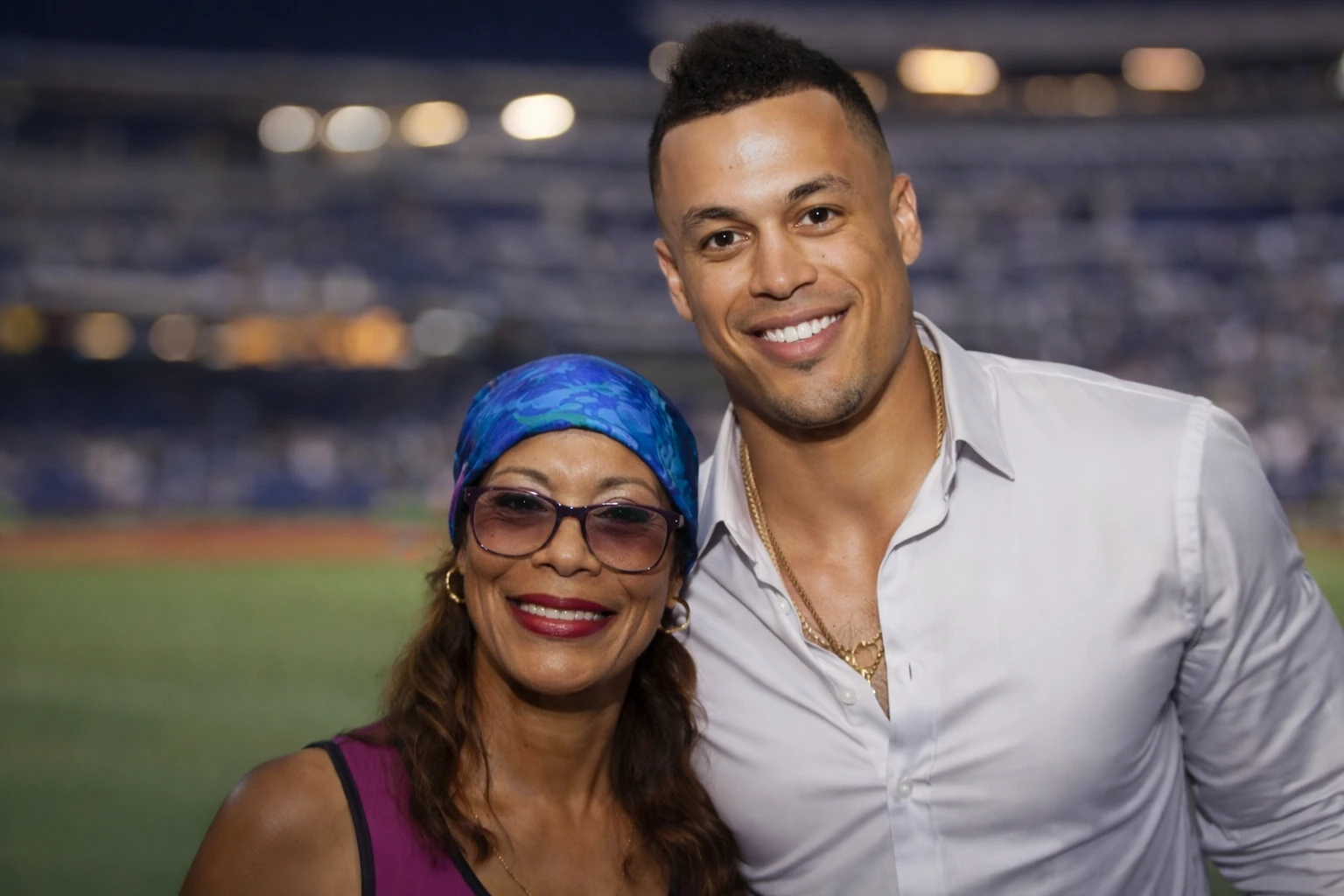
Jacinta Garay does not live a public life, yet her name continues to circulate in headlines, fan searches, and biographical sidebars tied to one of baseball’s most recognizable sluggers, Giancarlo Stanton. That kind of attention can distort reality. It often turns a private individual into a semi-public figure without the benefit of interviews, official profiles, or verified documentation. What remains, if you strip away the repetition and speculation, is a quieter story—one about family, heritage, and the indirect influence that shapes a public figure’s identity.
Garay is best known as the mother of Giancarlo Stanton, the New York Yankees designated hitter and one of Major League Baseball’s most powerful hitters of the modern era. That connection alone explains why her name appears in search results. But unlike many parents of high-profile athletes, she has not cultivated a public persona, and there is no widely documented career or media presence that defines her independently. The interest surrounding her is rooted in proximity, not publicity.
Understanding Jacinta Garay requires approaching her story with restraint. The available public record is limited, and many widely circulated details lack strong sourcing. What can be said with confidence is grounded in verified connections, contextual reporting about Stanton’s background, and the broader picture of how family shapes identity in professional sports.
Early Life and Background
There is no detailed, independently verified public biography outlining Jacinta Garay’s early life, education, or upbringing. This absence is important to acknowledge, especially in an era where online profiles often fill gaps with unverified claims. Several websites suggest specific dates or places of birth, but those details are not consistently supported by primary or mainstream sources.
What can be traced more reliably is the cultural background associated with her family line. Through Giancarlo Stanton’s own public statements and coverage by major outlets, Garay is connected to Puerto Rican heritage. That connection has been referenced in sports journalism and reinforced by Stanton’s engagement with Puerto Rico in community and baseball-related events.
This piece of identity carries weight beyond simple genealogy. It reflects how family heritage can remain present even when personal details stay private. In Garay’s case, her background is most visible through how her son describes his own lineage and sense of belonging.
Family and Relationship to Giancarlo Stanton
Jacinta Garay is part of the immediate family structure that shaped Giancarlo Stanton early life. Stanton was born on November 8, 1989, in Panorama City, California, and raised in Southern California. His upbringing, like that of many professional athletes, involved the steady presence of family influence, even when those family members stayed out of public view.
Stanton has spoken at times about his family in broad terms, particularly when discussing identity and naming. His full name, Giancarlo Cruz-Michael Stanton, reflects a blend of cultural influences, and reporting has noted that his mother calls him “Cruz,” drawn from his middle name. It is a small detail, but one that offers a glimpse into private family dynamics rarely seen in public coverage.
Here’s where it gets interesting. Stanton’s decision to move away from the name “Mike Stanton,” which he used earlier in his career, was framed as a return to his original identity rather than a reinvention. That return carries implicit ties to family, including the name given at birth and the cultural background it represents. In that sense, Garay’s influence appears less through public statements and more through the foundational elements of her son’s identity.
Cultural Heritage and Puerto Rican Roots
One of the most consistently supported aspects of Jacinta Garay’s background is her connection to Puerto Rican ancestry. This has been discussed in reputable sports coverage, particularly in relation to Stanton’s own identity.
In interviews and community appearances, Stanton has acknowledged that part of his heritage comes from Puerto Rico through his mother’s side. Reporting has also indicated that his maternal great-grandmother was born in Ponce, Puerto Rico. These details have been used to explain his participation in baseball outreach efforts on the island and his expressed interest in connecting with that part of his family history.
The significance of this connection goes beyond ancestry. For Stanton, it has been a way to engage with a broader cultural identity within baseball, a sport where Latin American and Caribbean heritage plays a major role. For Garay, even without public commentary, it places her within a lineage that has contributed to shaping how her son sees himself and how he is seen by others.
Not many people know this, but heritage stories in sports often carry more weight than individual biographies. They create a sense of continuity between generations, and in Garay’s case, her role in that continuity is one of the clearest elements of her public identity.
Public Visibility and Media Presence
Jacinta Garay’s public visibility is limited and largely indirect. She has not built a media presence, given interviews, or maintained a known public-facing career that places her in the spotlight. Instead, her appearances in public discourse come through curated moments, such as family features or league-driven content.
One example is her inclusion in MLB’s Mother’s Day features, where players and their mothers are highlighted together. These appearances are typically brief and symbolic, offering acknowledgment rather than detailed biography. They reinforce her identity as Stanton’s mother without expanding into broader personal storytelling.
The truth is, Garay represents a category of individuals who are widely searched but rarely documented. This gap creates a tension between curiosity and privacy. Readers want to know more, but the available information does not support a full portrait in the way it might for a public figure.
That said, her limited visibility also reflects a deliberate distance from the spotlight. Many parents of professional athletes choose not to engage publicly, allowing their children’s careers to define the family’s public narrative. Garay appears to fall into that group.
The Internet Biography Problem
Search results for “Jacinta Garay” reveal a pattern that is common in celebrity-adjacent profiles. Numerous websites present detailed accounts of her life, including specific birth dates, occupations, and financial information. However, these details are often repeated across platforms without clear sourcing.
This repetition creates the illusion of confirmation. When multiple sites list the same information, it can seem authoritative, even if all of them are drawing from the same unverified origin. For readers, the challenge is distinguishing between widely circulated claims and genuinely confirmed facts.
The more cautious approach is to rely on established reporting standards. In Garay’s case, that means focusing on what is supported by major sports outlets and official league content. Anything beyond that should be treated as uncertain unless backed by credible documentation.
This is not a limitation of the story but a reflection of responsible reporting. It acknowledges the difference between public interest and public record, especially when the subject is not a public figure in the traditional sense.
Personal Life and Privacy
There is little publicly confirmed information about Jacinta Garay’s personal life beyond her role as a mother. Details about her relationships, marital status, or professional career are not consistently documented in reliable sources. While some online profiles attempt to fill in these gaps, they do so without clear evidence.
What’s surprising is how often privacy becomes part of the story itself. In Garay’s case, the lack of information has not reduced public interest; it has increased it. The less that is known, the more speculation tends to grow.
But here’s the thing. Respecting that boundary is part of responsible storytelling. Not every person connected to a public figure is obligated to share their life with the world. Garay’s limited public presence suggests a preference for privacy, and that preference shapes how her story can be told.
Influence Without Public Presence
Influence does not always require visibility. In many cases, it operates quietly, through upbringing, values, and early support. While there are no detailed public accounts of Garay’s role in Stanton’s development, it is reasonable to recognize that family plays a foundational role in any athlete’s path.
Stanton’s rise to professional baseball began in Southern California, where he developed his skills through local leagues and school programs. That environment would have involved family support, even if the specifics are not documented. Garay’s presence in that context is implied rather than described.
This kind of influence is difficult to measure but easy to recognize. It appears in the stability of a player’s early life, the cultural identity they carry, and the decisions they make about how to present themselves publicly. In Stanton’s case, those elements point back to family, including his mother.
Public Interest and Continuing Relevance
Jacinta Garay’s relevance in public search is tied directly to Giancarlo Stanton’s ongoing career. As long as Stanton remains active in Major League Baseball, interest in his background and family will continue.
Recent years have kept Stanton in the spotlight, both for his performance and his health. Coverage of his career inevitably leads back to biographical details, and Garay’s name appears as part of that narrative. This cycle keeps her presence alive in public discourse, even without new information about her life.
The relationship between athlete and family is a recurring theme in sports storytelling. Fans often look for context beyond the field, seeking to understand the people who shaped the player they watch. Garay’s role in that context ensures that her name remains relevant, even if the details remain limited.
Frequently Asked Questions
Who is Jacinta Garay?
Jacinta Garay is best known as the mother of Major League Baseball player Giancarlo Stanton. Her name appears in official MLB content and sports reporting in connection with Stanton’s family background. Beyond that relationship, there is limited verified public information about her life.
Is Jacinta Garay a public figure?
No, she is not considered a public figure in the traditional sense. She has not built a media presence or public career and is primarily known through her connection to her son. Most of the available information about her comes indirectly from sports coverage.
What is known about her heritage?
Garay is associated with Puerto Rican heritage through her family line. This has been referenced in coverage of Giancarlo Stanton’s background and his engagement with Puerto Rico. Specific genealogical details beyond that connection are limited in public sources.
Are there confirmed details about her career or profession?
There are no widely confirmed details about her professional life. Some online sources claim specific occupations, but these claims are not consistently supported by reliable or primary sources. As a result, they should be treated with caution.
Why is there so much conflicting information about her?
The limited public record has led to speculation and repetition across online profiles. Many websites copy information from each other without verifying it, creating inconsistencies. This makes it difficult to separate fact from assumption.
Does she appear in media or interviews?
There is no strong record of Jacinta Garay giving interviews or maintaining a public-facing media presence. Her appearances are limited to brief mentions or features connected to her son’s career.
Conclusion
Jacinta Garay’s story is defined as much by what is not known as by what is. She exists in public awareness because of her connection to a high-profile athlete, yet she has maintained a level of privacy that is increasingly rare in the digital age. That balance shapes how her biography can be told.
The available facts point to a role rooted in family, heritage, and influence rather than public achievement or media visibility. Her connection to Puerto Rican ancestry and her place in Giancarlo Stanton’s life are the clearest elements of her public identity. Beyond that, the story becomes quieter, more restrained.
There is value in that restraint. It reflects the reality that not every life connected to fame needs to be fully documented or publicly dissected. In Garay’s case, the absence of detail is not a gap to be filled but a boundary to be respected.
What remains is a portrait defined by connection rather than exposure. It is a reminder that behind every public figure is a network of private lives, some of which remain intentionally out of view. Jacinta Garay stands within that space, known but not fully seen, and that may be the most accurate way to understand her place in the public record.
