
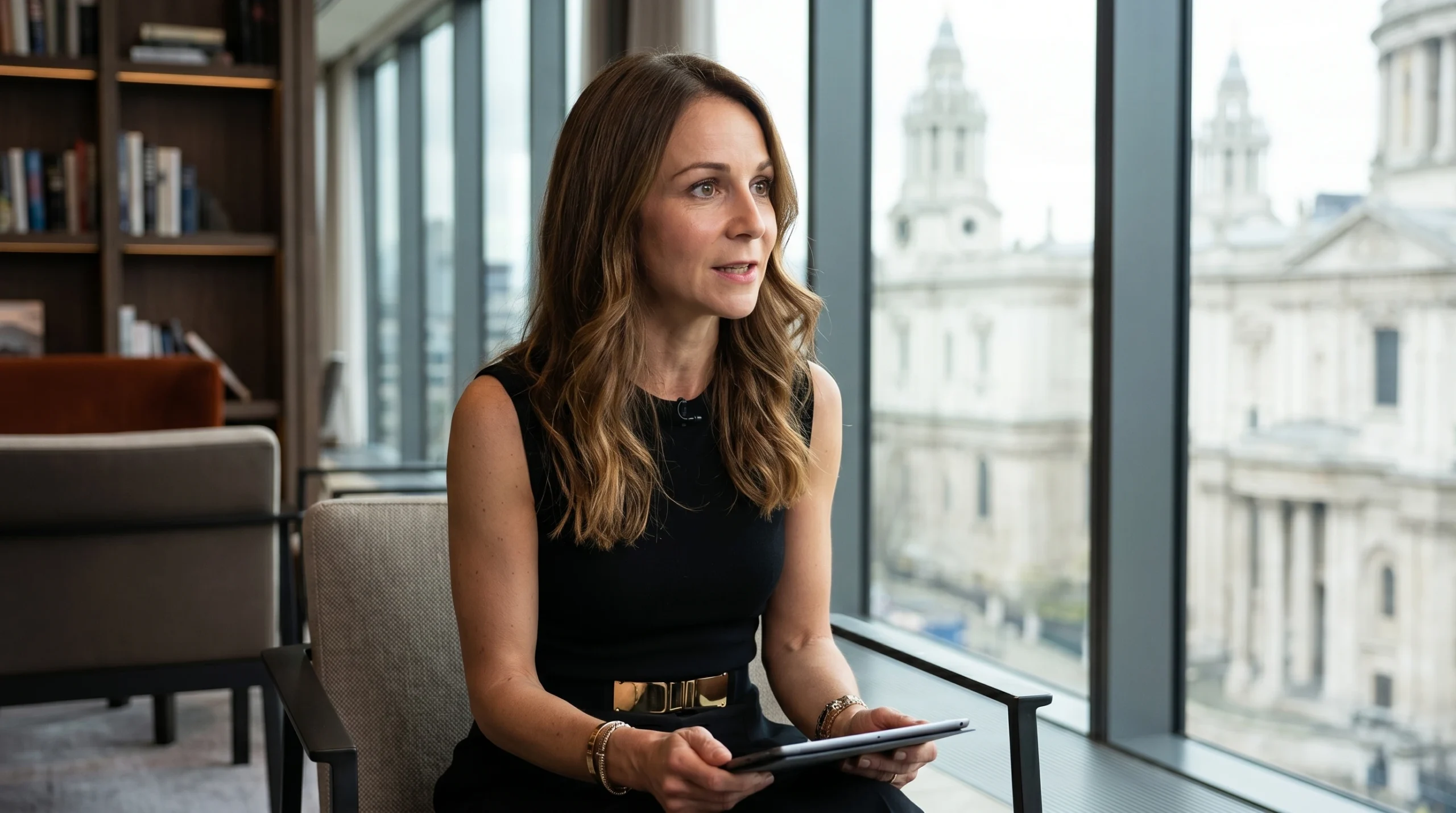
Annabel Denham is the kind of British political commentator many viewers recognize before they can place her biography. She appears in the places where Westminster argument meets national media: newspaper opinion pages, television panels, think-tank debates, and policy discussion. That visibility explains why so many people search for “Annabel Denham Wikipedia” even though a full public biography is harder to find than her professional footprint. The clearest picture of Denham is not built from gossip or guesswork, but from a career that has moved through Parliament, business journalism, free-market policy work, and national newspaper commentary.
For readers trying to understand who she is, the short answer is this: Annabel Denham is a British journalist, editor, and political commentator best known for her work at The Telegraph and for her earlier roles at the Institute of Economic Affairs, The Entrepreneurs Network, City A.M., and in Parliament. Her public voice is associated with right-of-centre political argument, economic liberalism, entrepreneurship, and skepticism toward overextended government. She is not a celebrity in the conventional sense, and she has kept much of her personal life out of public view. That makes a careful biography more useful than a speculative one.
Early Life and Family
Annabel Denham’s early life is not widely documented in reliable public sources. Unlike actors, athletes, or elected politicians, she has not built her public profile around childhood stories, family history, or personal revelation. That privacy is common among journalists and commentators, especially those whose work is about politics rather than their own lives. It also means that many online claims about her family background should be treated with caution unless they are supported by a credible source.
There is no strong public record confirming her parents’ names, siblings, hometown, or childhood circumstances. Some biography-style websites make broad claims about her background, but those pages often repeat one another without showing where the details came from. A responsible profile should not turn that silence into invented detail. What can be said safely is that Denham’s public career has been shaped far more by Westminster, journalism, policy, and business debate than by a publicly documented family story.
The absence of personal detail does not make her biography thin. It simply shifts the focus to the public record, where there is a clearer trail. Denham’s professional life shows someone who entered political and economic argument early, then built a career across the institutions that shape British public debate. That story is revealing in its own way. It shows how a commentator can become influential without becoming a household-name celebrity.
Education and Early Ambitions
Denham’s education has been mentioned on some public biography pages, but the strongest professional profiles tend to focus more on her career than on her schooling. Several online listings have connected her with the University of Manchester and SOAS, University of London, though readers should understand that education details are less consistently documented than her employment history. Because of that, they should be treated with care rather than repeated as the foundation of her biography. The better-established story begins with her early professional work in politics and journalism.
Her career path suggests a strong early interest in public affairs, policy, and argument. Work in Parliament, business journalism, and think-tank communications requires a particular mix of skills: speed, judgment, political awareness, and the ability to turn technical subjects into clear public language. Denham’s later career shows all of those traits. She became known not as a lifestyle columnist or celebrity interviewer, but as someone comfortable discussing tax, regulation, business, public spending, and the state.
That kind of work often attracts people who are interested in both ideas and institutions. Westminster teaches how policy is made and contested. Business journalism teaches how decisions affect companies, workers, investors, and entrepreneurs. Think-tank work teaches how arguments are packaged for public and political impact. Denham’s path brought those worlds together before she became most visible as a newspaper commentator.
First Steps in Westminster
One of Denham’s earliest widely cited roles was as a parliamentary researcher for Lord Peter Lilley, the former Conservative cabinet minister. A parliamentary research job is often demanding, practical, and politically formative. It can involve briefing, policy work, speech preparation, correspondence, media monitoring, and close attention to the daily rhythms of Westminster. For a future commentator, it is a useful education in how politics works when the cameras are not on.
Lord Lilley’s own political profile also helps explain the ideological environment around Denham’s early career. He was associated with Conservative politics, market-oriented policy arguments, and cabinet-level government experience. Working for a figure of that kind would have exposed a young researcher to debates about the economy, welfare, Europe, enterprise, and the role of the state. It would also have offered a close view of how political arguments are sharpened for Parliament and the press.
This part of Denham’s career matters because it connects her later journalism to real political process. She did not arrive in commentary only through media training or general opinion writing. She had experience inside the political system, at least from the research and policy side. That background gives context to her later work, where she often writes about government promises, policy costs, and the gap between political language and practical delivery.
City A.M. and Business Journalism
After her Westminster work, Denham moved through business journalism, including roles associated with City A.M. The publication is known for its focus on finance, business, markets, entrepreneurship, and London’s commercial life. That environment differs sharply from general political reporting. It pushes writers to think about regulation, investment, productivity, taxes, labour markets, and the pressures facing companies.
Denham has been described in professional profiles as having worked at City A.M. in business features and entrepreneurship-related editing. That experience is important because it gave her a bridge between politics and the economy. Many political commentators discuss business from a distance, but business journalism forces attention to the people affected by policy choices. It also encourages a sharper sense of how government decisions can alter incentives, costs, and confidence.
Her later writing often carries traces of that background. She tends to approach political debate through outcomes rather than slogans. If a minister promises a new rule, tax, benefit, or ban, the natural question in her kind of commentary is what it will do in practice. That outlook is not neutral, and readers do not have to share it. But it is consistent with a career shaped by business journalism and policy work.
The Entrepreneurs Network and the Female Founders Forum
A major stage in Denham’s career came through The Entrepreneurs Network, where she worked between 2015 and 2020. The organization focuses on entrepreneurship, start-ups, business growth, and the conditions that help or hinder founders. Denham has been described as an Associate Director there and as someone who worked closely on the Female Founders Forum. That role placed her in a policy area where economics and gender debates meet.
The Female Founders Forum focused on women who start and grow businesses. That subject is more practical than symbolic because women entrepreneurs often face barriers involving finance, networks, childcare, investor assumptions, and confidence in the start-up system. Denham’s work in that space connected her to debates about women in work and enterprise. It also showed a side of her career that is sometimes missed when she is described only as a political commentator.
This period helped establish Denham as someone interested in entrepreneurship as a public-policy issue. Start-ups are not affected only by ambition or talent; they are shaped by tax rules, planning systems, access to capital, employment law, and the broader attitude of government toward risk. Denham’s later commentary often reflects that concern with incentives. She writes from a tradition that sees enterprise not as a side issue, but as central to prosperity and political choice.
Institute of Economic Affairs
In 2020, Denham joined the Institute of Economic Affairs as Director of Communications. The IEA is one of Britain’s best-known free-market think tanks, and the role placed her at the center of a public argument about markets, the state, and individual freedom. Communications work at a think tank is not simply publicity. It involves shaping how research and ideas reach journalists, broadcasters, policymakers, and the wider public.
Her appointment came at a dramatic time. Britain was dealing with Brexit’s aftermath, changing Conservative leadership, and soon the Covid-19 pandemic. The pandemic in particular created intense debate about lockdowns, personal freedom, public health, government borrowing, and the long-term economic cost of emergency policy. For an organization such as the IEA, those debates went to the heart of its mission. Denham’s role meant helping present free-market arguments during one of the most intervention-heavy periods in modern British government.
The IEA connection is one reason readers often associate Denham with right-of-centre or market-liberal politics. That association is fair, as long as it is not treated as a substitute for reading her work. She has been part of institutions and publications that care deeply about economic freedom, limited government, and enterprise. Her commentary is best understood against that background, not reduced to a party label.
Move to The Telegraph
Denham’s most visible national role has been at The Telegraph, where she has worked in opinion journalism and political commentary. Professional profiles have described her as Deputy Comment Editor, Senior Political Commentator, and as someone who previously ran the paper’s opinion desk. Titles in newsrooms can change, but the broader point is clear. Denham became part of one of Britain’s most influential conservative-leaning newspaper opinion operations.
The Telegraph’s opinion pages occupy a distinct place in British media. They speak to politically engaged readers, Westminster insiders, Conservative voters, business audiences, and people who follow policy argument closely. Working in that environment requires quick judgment about which debates matter and which arguments will resonate. It also demands the ability to edit, commission, and write under pressure.
For Denham, The Telegraph role brought together earlier strands of her career. Her Westminster experience gave her political fluency. Her business journalism background gave her economic focus. Her think-tank work gave her familiarity with policy argument and broadcast debate. At The Telegraph, those skills could be expressed through commentary that reaches a much broader national audience.
Writing Style and Public Voice
Denham’s writing is direct, opinionated, and grounded in political argument. She often writes about the state, markets, taxation, public spending, work, regulation, and the culture of British politics. Her approach is not that of a detached news reporter. She writes as a commentator whose job is to make a case, challenge assumptions, and push readers to think about consequences.
That style has strengths and tradeoffs. Readers who agree with her instincts may find her clear, sharp, and refreshingly unsentimental about government promises. Readers who disagree may see her as too skeptical of public intervention or too sympathetic to free-market answers. That divide is part of the nature of opinion journalism. The value of the work depends not on universal agreement, but on whether the argument is clear enough to be tested.
Her background also gives her commentary a recognizable pattern. She is often interested in what policy does after the announcement has faded. Does a new rule help people or satisfy a political mood? Does a tax rise raise the money promised or weaken the activity being taxed? Does a social policy solve a real problem or turn anxiety into legislation? Those are the kinds of questions that place her within the British market-liberal comment tradition.
Television and Media Appearances
Denham has also appeared as a political commentator on British television and current-affairs programming. Her public profiles have connected her with appearances on outlets such as Sky News, and her think-tank role brought her into the broadcast cycle during major policy debates. Television work is a different discipline from writing. It rewards speed, compression, and the ability to defend a position in real time.
Broadcast appearances help explain why her name is searched beyond regular newspaper readers. A viewer may see her on a panel discussing the government, the economy, or a newspaper front page, then search for her biography within minutes. That is often where the “Wikipedia” query begins. People want to know whether she is a journalist, a politician, a campaigner, or a think-tank figure.
The answer is that she has been several of those things professionally, though not an elected politician. She has worked in Parliament as a researcher, in think tanks and policy networks, and in national journalism. That combination is common in British public debate, where the boundaries between policy work, commentary, and broadcast analysis are often porous. Denham’s media profile reflects that system.
Marriage, Partner, and Children
Annabel Denham has not made her romantic life or family life a central part of her public profile. There is no reliable, widely established public record confirming whether she is married, who her partner may be, or whether she has children. Some search-driven biography websites may offer claims, but those claims should not be treated as confirmed without credible sourcing. Privacy is especially important here because Denham is known for her professional work, not for selling access to her personal life.
A careful biography should not punish a public figure for keeping private matters private. Journalists and commentators often speak forcefully in public while drawing firm boundaries around family. That boundary is reasonable. It allows the reader to focus on the work, the arguments, and the career.
This does not mean readers are wrong to be curious. Public visibility naturally creates curiosity about the person behind the byline or television appearance. But there is a difference between curiosity and public knowledge. In Denham’s case, the honest answer is that her family and relationship details are not clearly confirmed in reliable public sources.
Net Worth and Income Sources
There is no credible public estimate of Annabel Denham’s net worth. Figures that appear on generic biography websites should be treated as guesses unless they are backed by financial records or reputable reporting. Journalists, editors, commentators, and think-tank communications directors do not usually have publicly disclosed personal finances. Without contracts, assets, investments, property records, and other private details, any exact number would be misleading.
What can be described are her likely professional income sources. Denham’s career has included journalism, editing, political commentary, think-tank communications, policy work, and broadcast appearances. Some of those roles may involve salaries, freelance fees, speaking fees, or contributor payments. The exact mix is not public.
This is a useful place to be firm about standards. A biography should not invent wealth because readers search for it. If no solid figure exists, the right answer is not to fill the gap with a dramatic estimate. Denham appears to have built a stable professional career in media and policy, but her personal wealth is not publicly verified.
Public Image and Political Identity
Denham’s public image is shaped by her association with conservative and free-market spaces. The Telegraph, The Spectator’s Coffee House, CapX, the IEA, and entrepreneurship policy networks all point toward a writer interested in markets, growth, limited government, and the cost of state intervention. That profile places her within a recognizable current of British public debate. It also means readers often approach her work with strong expectations before reading a word.
But here’s the thing. Political identity in journalism is rarely as simple as a label. Denham’s work is not only about party politics; it is often about the machinery underneath political promises. She is interested in what happens when a policy meets employers, families, taxpayers, founders, public services, and voters. That gives her commentary a practical cast even when the argument is ideological.
Her critics are likely to challenge her assumptions about markets, inequality, social protection, and public services. Her supporters are likely to value her skepticism toward costly promises and state expansion. Both reactions are part of her standing as a commentator. She is not trying to be invisible in the debate; she is trying to shape it.
Why There May Not Be an Annabel Denham Wikipedia Page
Many readers search “Annabel Denham Wikipedia” because they expect a simple encyclopedia page to exist. As of the latest available public picture, there has not been a widely established standalone Wikipedia page for her. That does not mean she has no public significance. It means that Wikipedia’s own standards, editorial decisions, and sourcing requirements have not produced a dedicated page under her name.
Wikipedia entries depend on independent, reliable coverage that establishes lasting public interest. A person can be visible on television, write for a national newspaper, and still lack the kind of independent biographical coverage that sustains an encyclopedia article. This is especially true for working journalists and editors. Their work may be public, while their lives remain lightly documented.
The gap has created space for less reliable “wiki-style” pages. These sites often promise age, husband, salary, and net worth details that are not strongly sourced. They may rank in search results because they answer common questions quickly, not because they answer them well. Readers should treat them as starting points at best, and often as unreliable summaries.
Lesser-Known Details That Help Explain Her Career
One of the more meaningful details in Denham’s career is her work on women and entrepreneurship. It complicates a flat picture of her as only a political pundit. Through the Female Founders Forum, she worked in an area that examined why women start fewer high-growth companies and what policy might do about it. That subject connects economics with family life, finance, work culture, and social expectation.
Another useful detail is her movement between writing and communications. Some journalists spend their careers inside newsrooms, while some policy professionals remain behind institutional messaging. Denham has moved between both worlds. That has made her comfortable not only in writing arguments, but also in understanding how ideas travel through media systems.
Her career also reflects a wider British pattern. Westminster, think tanks, newspapers, and broadcasters form a small but powerful circuit. People move through that circuit, carrying ideas, contacts, and habits of argument with them. Denham’s biography is partly the story of one person, and partly a window into how British political commentary is made.
Current Status
Denham’s current public status is that of a journalist, editor, and commentator associated with national political debate. Her most visible work is linked to The Telegraph and to commentary on British politics, policy, and public life. She remains part of the conversation around the Conservative Party, economic policy, social regulation, and the direction of Britain’s state. Her earlier think-tank and entrepreneurship work continues to shape how readers understand her point of view.
She is not best described as a celebrity or a traditional public official. Her influence is editorial and argumentative rather than electoral. She writes, edits, comments, and appears in media spaces where politically attentive audiences gather. That kind of influence can be subtle, but it matters because public opinion is often shaped before formal political decisions are made.
For readers searching her name, the most useful current framing is simple. Annabel Denham is a media and policy figure whose career bridges journalism, Westminster, and free-market thought. Her public record is strongest on career and commentary, much weaker on personal biography. Any honest profile has to respect that difference.
Frequently Asked Questions
Who is Annabel Denham?
Annabel Denham is a British journalist, editor, and political commentator. She is best known for her work at The Telegraph and for earlier roles linked to the Institute of Economic Affairs, The Entrepreneurs Network, City A.M., and Parliament. Her commentary often focuses on British politics, economic policy, regulation, taxation, and the role of the state. She is associated with right-of-centre and free-market public debate.
Does Annabel Denham have a Wikipedia page?
There does not appear to be a widely established standalone Wikipedia page for Annabel Denham. The search term “Annabel Denham Wikipedia” is popular because readers want a quick biography, but many results lead to generic profile sites rather than Wikipedia itself. Those pages may mix confirmed career facts with unsourced personal claims. A careful reader should rely on professional profiles, published work, and institutional records.
How old is Annabel Denham?
Annabel Denham’s exact age and date of birth are not clearly confirmed in reliable public sources. Some online biography pages give estimates, but those estimates should not be treated as fact unless supported by a credible source. Her public biography is much clearer on her career than on her private background. The honest answer is that her age is not publicly verified.
Is Annabel Denham married?
There is no reliable public confirmation of Annabel Denham’s marital status. She has not made her private romantic life a central part of her public identity. Claims about a husband, partner, or children should be treated carefully unless they come from a credible source. Her known public profile is based on journalism, commentary, and policy work.
What is Annabel Denham’s net worth?
Annabel Denham’s net worth is not publicly verified. Online figures should be treated as estimates at best and speculation at worst. Her income likely comes from journalism, editing, commentary, and related media or policy work, but the details are private. A precise net worth number would not be responsible without stronger evidence.
What are Annabel Denham’s political views?
Denham is generally associated with right-of-centre, market-liberal commentary. That association comes from her work with the Institute of Economic Affairs, her writing on enterprise and regulation, and her roles in conservative-leaning media spaces. She often writes about the cost and consequences of government action. Still, individual articles should be read on their own rather than reduced to a single label.
What is Annabel Denham doing now?
Annabel Denham remains publicly known as a political commentator and newspaper journalist. Her current profile is most closely tied to The Telegraph and to British political debate. She continues to be discussed by readers who follow Westminster, economic policy, and conservative media. Her public work, rather than her private life, remains the clearest record of who she is.
Conclusion
Annabel Denham’s biography is not the story of a celebrity who has lived in front of cameras. It is the story of a journalist and policy-minded commentator who has built influence through ideas, institutions, and argument. Her path from Parliament to business journalism, entrepreneurship policy, the IEA, and The Telegraph explains why she is a familiar name in British political media. It also explains why readers search for a Wikipedia-style account that can separate fact from online filler.
The strongest version of her profile is careful rather than flashy. It confirms what the public record supports: her work in Westminster, City A.M., The Entrepreneurs Network, the Institute of Economic Affairs, and national opinion journalism. It also admits what is not confirmed: her exact age, family background, marriage, children, and personal wealth. That honesty makes the biography more useful, not less.
Denham still matters because she occupies a live and contested space in British public debate. She writes from a tradition that cares about markets, enterprise, limited government, and the practical consequences of political choices. Readers may agree with her, challenge her, or return to her work to understand a particular strand of conservative and free-market thought. The fairest way to read Annabel Denham is to begin with the record, respect the privacy she has kept, and judge the public figure by the arguments she puts into the world.
