
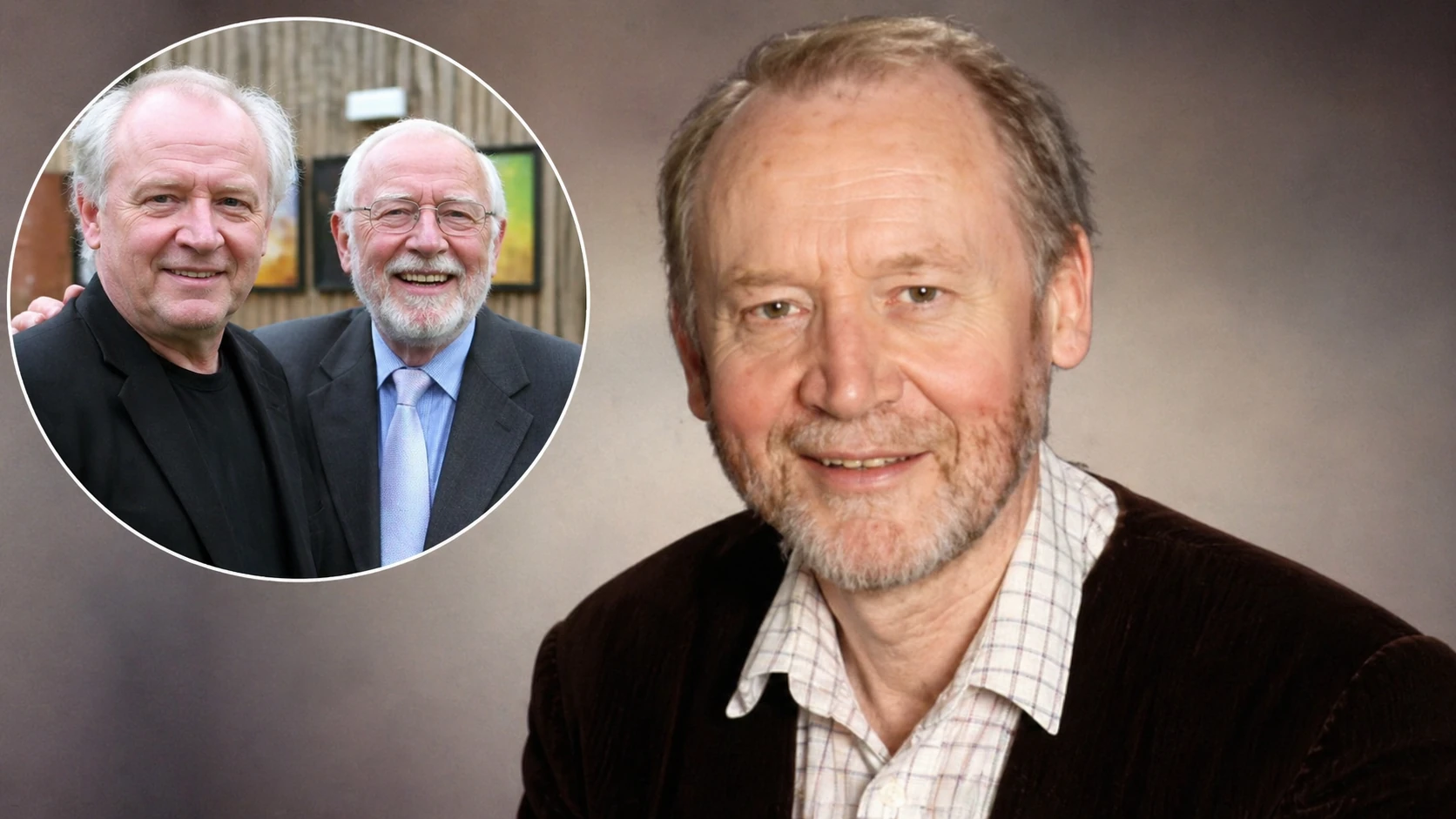
For most people, the name Attenborough immediately brings to mind a familiar voice narrating the wonders of the natural world. But behind that legacy is a quieter story—one that belongs to Robert Attenborough, the son of Sir David Attenborough, who chose a very different path. Instead of stepping into the public spotlight, he built a life in academia, studying human biology, health, and population history in some of the world’s most complex environments.
Robert Attenborough has never been a household name, and that has largely been by design. While his father became one of the most recognizable figures in broadcasting history, Robert pursued a career defined by research, teaching, and fieldwork. His story is not about celebrity but about intellectual curiosity, scientific rigor, and a commitment to understanding how humans live, adapt, and survive.
Early Life and Family
Robert David Attenborough was born in August 1951 in the United Kingdom. He grew up in a family already deeply connected to science, culture, and public life. His father, Sir David Attenborough, had begun his career in broadcasting and would go on to become one of the most influential natural historians of the 20th and 21st centuries. His mother, Jane Elizabeth Ebsworth Oriel, provided stability at home while David’s career took him across the globe.
Robert was not the only child in the family. He has a sister, Susan Attenborough, who also stayed largely out of the public eye. The family valued education and intellectual curiosity, which shaped Robert’s early interests. But unlike his father, whose work brought him in front of cameras, Robert gravitated toward the quieter, analytical side of science.
Growing up with a globally recognized parent could easily have led him toward a similar public-facing career. Instead, Robert’s upbringing seems to have encouraged independence rather than imitation. He did not attempt to follow in his father’s footsteps in media. Instead, he found his own direction in the study of human biology and anthropology.
Education and Academic Direction
Details about Robert Attenborough’s early education are not widely publicized, which reflects his preference for privacy. However, his later academic positions suggest a strong educational background in biological sciences or anthropology. His career path points toward training that combined biology, human evolution, and population studies.
What becomes clear is that he developed a strong interest in how human populations adapt to their environments. That focus would define his work for decades. Rather than concentrating on laboratory-based biology, he leaned toward field-based research, where data is gathered directly from communities and ecosystems.
His academic development aligns with the broader field of biological anthropology, which studies humans through a combination of biology, culture, and environment. This discipline requires not only scientific training but also the ability to work across cultures and interpret complex social systems.
Career at the Australian National University
One of the most significant chapters in Robert Attenborough’s professional life has been his association with the Australian National University (ANU) in Canberra. He served as a senior lecturer in biological anthropology, where he contributed to both teaching and research.
His move to Australia was not framed as a dramatic career shift. In a rare public comment, he once explained that he simply applied for a job at ANU and accepted the offer when it came. That straightforward explanation reflects his practical approach to his career. It was not driven by public recognition but by academic opportunity.
At ANU, Robert focused on human population biology, health, and demography, particularly in Papua New Guinea. His work involved studying how environmental conditions, disease patterns, and cultural practices influence human biology. These are complex questions that require long-term research and collaboration with local communities.
Even after stepping back from full-time roles, he has remained connected to ANU as an Honorary Senior Lecturer. This ongoing affiliation suggests that his influence continues through mentorship, collaboration, and academic contribution rather than administrative leadership.
Research Focus: Papua New Guinea and Human Biology
A defining feature of Robert Attenborough’s career is his long-standing research in Papua New Guinea. This region has drawn the attention of scientists for decades due to its extraordinary diversity. It is home to hundreds of languages, varied ecosystems, and populations with distinct biological and cultural histories.
Robert’s work in this area has explored how human populations adapt to challenging environments. This includes studying nutrition, disease exposure, reproductive patterns, and genetic variation. His research contributes to a broader understanding of how humans survive and evolve under different conditions.
One of his most recognized contributions is his role as co-editor of Human Biology in Papua New Guinea: The Small Cosmos, published in 1992. The book brought together research on topics such as health, genetics, nutrition, and epidemiology. It positioned Papua New Guinea as a microcosm for studying broader human biological questions.
The title itself reflects an important idea: that a relatively contained region can reveal insights into global human patterns. This approach has influenced how researchers think about population biology and the connections between environment and health.
Academic Contributions and Publications
Robert Attenborough’s academic work extends beyond a single book. He has contributed to edited volumes, journal articles, and collaborative research projects. His work often sits at the intersection of biology, anthropology, and public health.
In 2005, he contributed to Papuan Pasts: Cultural, Linguistic and Biological Histories of Papuan-speaking Peoples. This volume examined the deep history of populations in the region, combining evidence from multiple disciplines. Robert’s involvement highlights his role in bridging different fields of research.
More recently, his work has engaged with advances in genetics and evolutionary biology. Studies connected to his research have explored how genetic variation reflects population history and adaptation. These findings are part of a broader shift in anthropology, where genetic data is increasingly used alongside traditional fieldwork.
In 2020, he co-authored a study examining whether well-regarded hunters in the Hadza community of Tanzania—and their partners—experience measurable nutritional benefits. The findings challenged common assumptions, showing that social reputation does not necessarily translate into better nutrition. This kind of work demonstrates his interest in testing widely held beliefs against empirical evidence.
Connection to the University of Cambridge
In addition to his work in Australia, Robert Attenborough has been associated with the University of Cambridge. He has been listed as a Senior Fellow at the McDonald Institute for Archaeological Research, a position that reflects both experience and recognition within the academic community.
This connection to Cambridge is not surprising, given the Attenborough family’s historical ties to the university. David Attenborough himself studied natural sciences there. For Robert, however, the affiliation represents his own academic standing rather than inherited prestige.
At Cambridge, his work has continued to focus on human population biology and evolutionary anthropology. His involvement in research institutes suggests ongoing engagement with current debates in the field, even later in his career.
Personal Life and Privacy
Robert Attenborough has maintained a notably private personal life. Unlike many individuals connected to high-profile families, he has not sought media attention. As a result, there is limited publicly confirmed information about his relationships, marriage, or children.
This absence of detail is not unusual for academics who do not work in the public sphere. It also reflects a clear boundary between his professional and personal life. While his father’s career required public visibility, Robert’s work did not.
What can be confirmed is his close family connection to David Attenborough and his continued presence in academic circles. Beyond that, much of his personal life remains outside the public record, and responsible reporting respects that boundary.
Financial Standing and Net Worth
There is no reliable public figure for Robert Attenborough’s net worth. Unlike media personalities or business figures, academics typically do not have widely reported financial profiles. His income would have come primarily from university positions, research work, and possibly consultancy roles.
Some online sources speculate about his wealth based on his family background. These estimates should be treated with caution, as they often lack verifiable evidence. While his father has accumulated significant wealth through decades of broadcasting, that does not automatically reflect Robert’s financial situation.
The most accurate conclusion is that his financial standing has likely been consistent with a senior academic career. Without confirmed data, any specific figure would be speculative.
Public Image and Relationship to Fame
Robert Attenborough occupies an unusual position. He is connected to one of the most recognizable names in global media, yet he has remained almost entirely outside the public spotlight. This contrast shapes how he is perceived.
To those who discover him through search, he often appears as a footnote to his father’s story. But a closer look reveals a career that stands on its own terms. His contributions to biological anthropology may not be widely known, but they are meaningful within his field.
There is also a broader cultural point here. Not everyone connected to fame seeks it. Robert’s life illustrates that it is possible to build a respected career without public attention, even when that attention is readily available.
Where Robert Attenborough Is Now
As of recent records, Robert Attenborough remains connected to academic institutions, particularly the Australian National University and the University of Cambridge. His roles have shifted toward honorary and senior research positions, which is typical for academics at later stages of their careers.
He continues to be involved in research related to human biology and New Guinea. His recent contributions to academic publications suggest ongoing engagement with developments in genetics and population studies.
While he is no longer in the early stages of his career, his work continues to influence research in his field. His presence in academic networks indicates that he remains an active and respected figure among colleagues.
Frequently Asked Questions
Who is Robert Attenborough?
Robert Attenborough is a British biological anthropologist and the son of Sir David Attenborough. He is known for his academic work on human population biology, particularly in Papua New Guinea, and has been affiliated with institutions such as the Australian National University and the University of Cambridge.
How old is Robert Attenborough?
Robert Attenborough was born in August 1951. As of 2026, he is 74 years old and will turn 75 later in the year.
What does Robert Attenborough do for a living?
He has spent most of his career as an academic, working as a lecturer and researcher in biological anthropology. His work focuses on human biology, health, and population studies, often involving field research in regions such as Papua New Guinea.
Is Robert Attenborough related to David Attenborough?
Yes, Robert Attenborough is David Attenborough’s son. He is one of two children from David’s marriage to Jane Elizabeth Ebsworth Oriel.
Is Robert Attenborough married?
There is no widely confirmed public information about Robert Attenborough’s marital status or family life. He has kept his personal life private.
What is Robert Attenborough’s net worth?
There is no verified public estimate of Robert Attenborough’s net worth. His career has been primarily academic, and financial details are not publicly disclosed.
Does Robert Attenborough work in television like his father?
No, Robert Attenborough has not pursued a career in television or media. His professional work is in academia, specifically in biological anthropology and research.
Conclusion
Robert Attenborough’s life is a reminder that influence does not always come with visibility. While his father became a global figure, Robert chose a path grounded in research and teaching. His work may not be widely recognized outside academic circles, but it has contributed to important discussions about human biology and adaptation.
His career shows a quiet consistency. He did not chase public recognition or build a persona around his family name. Instead, he focused on the steady work of scholarship, often in challenging environments and complex research settings.
What stands out is not what he avoided, but what he built. A career in biological anthropology requires patience, discipline, and a willingness to engage deeply with human diversity. Robert Attenborough has done that over decades, leaving a record that speaks through research rather than publicity.
For readers who arrive through curiosity about the Attenborough name, the deeper story is worth discovering. It is not a story of fame, but of focus—and in many ways, that makes it more enduring.
